
You may have seen the word “Zionist” in the news, in a history class, or in a heated comment section. Now you want to know what it really means.
Here is the Zionist meaning in one line: a Zionist is a person who supports Zionism, the movement that worked to create a Jewish state in the land of Israel and now supports that state.
That is the dictionary answer. The way people use the word in real life is a bit more complicated, and this guide covers both.
What Is the Meaning of Zionist?
A Zionist is someone who supports Zionism, the political movement for a Jewish homeland in Israel. Dictionaries agree on this.
Merriam-Webster defines a Zionist as a supporter of Zionism.
The Oxford Learner’s Dictionary says it means a person who supports Zionism, which it describes as a political movement supporting the development and protection of the state of Israel.
Here are the basic facts about the word:
- Part of speech: It works as a noun (“She is a Zionist”) and as an adjective (“a Zionist organization”).
- Pronunciation: ZY-uh-nist. Three syllables, with the stress on the first one.
- Spelling: Always use a capital Z. The word comes from Zion, a place name.
- Plural: Zionists.
- Related noun: Zionism, the movement itself. It has no plural in normal use.
Zionist Meaning in Simple Words
Think about the word “environmentalist.” An environmentalist is someone who supports environmentalism, the idea that we should protect nature. You don’t need a special passport or a special family to be one. You just hold the belief.
“Zionist” works the same way. It names a belief, and the belief is that the Jewish people should have a country of their own in Israel. Three quick rules help you remember it:
- It’s about belief, not birthplace. A Zionist can live in Texas, London, Toronto, or Tel Aviv.
- It’s not a religion. The religion in this story is Judaism. Zionism is a political movement.
- It doesn’t mean agreeing on everything. Zionists have argued with each other about borders, religion, and leaders since the very beginning.
What Is Zionism?
People describe the movement in very different ways, and you should know both views:
- Supporters say Zionism is the right of the Jewish people to govern themselves in their ancient homeland. They point to centuries of persecution in Europe and elsewhere as the reason a safe country mattered.
- Critics say the movement caused great harm to the Arab people who already lived in the land. Many Palestinians describe 1948 as the Nakba, an Arabic word meaning “catastrophe,” when around 750,000 Palestinians fled or were forced from their homes.
A later section explains this disagreement in more detail. For now, keep one idea in mind. The dictionary meaning of Zionist stays the same even when people argue about the movement.
Where Does the Word Zionist Come From?
So when a modern movement needed a name, “Zion” was an easy pick. Zionism is simply “the Zion movement.”
You may also see Zion in other places:
- First name or place name. Zion National Park in Utah is one example.
- Christian use. Some Christian groups use “Zion” to mean heaven or the community of believers.
- Rastafari and music. Some songs use Zion to mean a promised, peaceful home.
A Short History of Zionism
Why did this movement start? In the 1800s, many peoples in Europe were demanding countries of their own. At the same time, Jewish people faced hatred and violent attacks, especially in the Russian Empire. Some Jewish thinkers decided that the answer was a Jewish homeland. Here is the timeline in short form.
| Year | What happened |
|---|---|
| 1880s | A group called Hovevei Zion (“Lovers of Zion”) helps Jewish families settle in Palestine. |
| 1890 | The word Zionism appears in print for the first time. |
| 1896 | Theodor Herzl, an Austrian journalist, publishes The Jewish State. |
| 1897 | Herzl holds the First Zionist Congress in Basel, Switzerland. About 200 delegates from 17 countries attend. The movement adopts a goal: a home for the Jewish people in Palestine, protected by public law. |
| 1917 | Britain issues the Balfour Declaration, promising support for a Jewish national home in Palestine. |
| 1948 | The State of Israel is declared. The war that follows causes the displacement Palestinians call the Nakba. |
| After 1948 | The word shifts. A Zionist now usually means someone who supports and defends the existing state of Israel. |
Notice that last row. Before 1948, a Zionist was working to create a state.
After 1948, a Zionist is usually backing a state that already exists. That is why dictionaries often give two stages in the definition.
Zionist Meaning in Urdu, Arabic, Chinese, and Other Languages
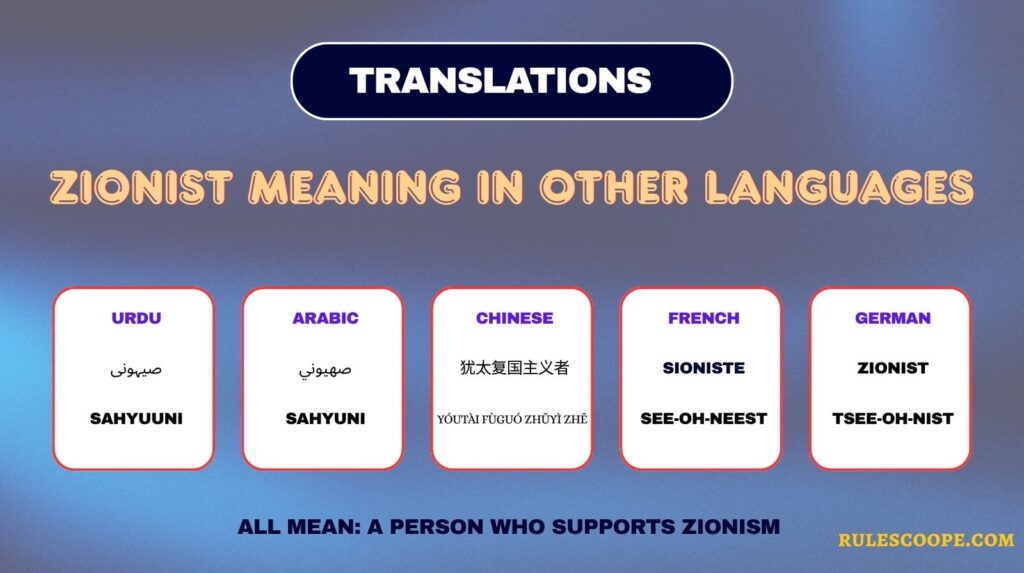
Many readers search for this word in their own language. Here are the most common translations.
| Language | Word | Sounds like | Meaning |
|---|---|---|---|
| Urdu | صیہونی (also written صہیونی) | sahyuuni | Zionist; supporter of Zionism |
| Arabic | صهيوني | sahyuni | Zionist; supporter of Zionism |
| Chinese | 犹太复国主义者 | Yóutài fùguó zhǔyì zhě | Zionist; supporter of Zionism |
| French | sioniste | see-oh-NEEST | Zionist |
| German | Zionist | tsee-oh-NIST | Zionist |
Who Can Be a Zionist?
Anyone who supports the idea can use the label. There is no test, no membership card, and no official list. Mostly, people call themselves Zionists, though others sometimes apply the label to them.
- Jewish people. Not every Jewish person is a Zionist. Jewish opinion has always been mixed. A Jewish Federations of North America survey, reported by the Forward, found that about one-third of American Jews call themselves Zionists. Yet almost 90% said they believe Israel has the right to exist as a democratic Jewish state. This shows that people use the label differently, even when they agree on the basics.
- Non-Jewish people. Christian Zionists are the biggest example. More on them below.
- People who live anywhere. You don’t have to live in Israel to be a Zionist. Many early supporters lived in Europe and the United States.
- People who disagree with each other. Some Zionists lean left, and some lean right. Some are religious, and some are not. Some support the current Israeli government, and others strongly criticize it.
Zionist vs. Israeli vs. Jewish: What’s the Difference?
These words get mixed up all the time. They answer different questions.
| Word | What it describes | Example |
|---|---|---|
| Zionist | A political belief | “She’s a Zionist.” |
| Israeli | Citizenship in the State of Israel | “He’s an Israeli citizen.” |
| Jewish | A religion, culture, and people | “They celebrate Jewish holidays.” |
| Judaism | The religion | “Judaism is thousands of years old.” |
| Zionism | The political movement | “Zionism began in the 1800s.” |
The groups overlap, but they are not the same. An Israeli citizen might not call themselves a Zionist. A person in Brazil or Canada might. A Jewish person might support Zionism, oppose it, or have no strong opinion.
What Is a Christian Zionist?
A Christian Zionist is a Christian who supports the Jewish people’s return to a homeland in Israel and who usually supports the State of Israel today. Most Christian Zionists are Evangelical Protestants, and the movement is strongest in the United States.
Why do they support Israel? Supporters give a few reasons:
- They read the Bible as promising the land to the Jewish people.
- They feel a debt of gratitude to Judaism, the root of their own faith.
- Some link the Jewish return to their beliefs about the end of the world.
The idea is old. In the 1890s, an Anglican minister named William Hechler offered to help Theodor Herzl win support for his plans.
Not everyone welcomes this support. Some Jewish groups worry that some Christian Zionists hope Jewish people will one day convert to Christianity. Defenders say that is not why they support Israel. Many Palestinian Christians also disagree strongly with Christian Zionism, saying it ignores the people already living in the land. Like the word “Zionist” itself, the term “Christian Zionist” means different things to different people.
Is Zionist a Good or Bad Word?
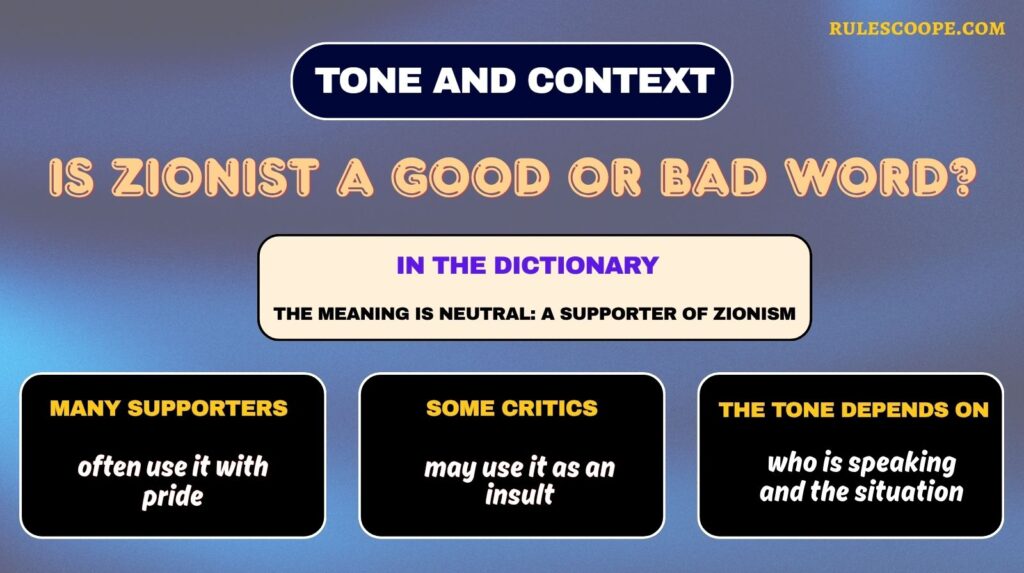
In a dictionary, “Zionist” is a neutral word. It describes what someone supports. Whether it sounds good or bad depends on who is speaking, who is listening, and what the sentence is about. This is a contested topic, so here are the main views side by side.
You do not have to pick a side to understand the word. You only need to know that the dictionary meaning is fixed and the feelings around it are not.
Zionist Meaning in Slang and on Social Media
“Zionist” is not a texting abbreviation, and it doesn’t have a slang meaning in dictionaries. But you will see it online, and the tone can change a lot.
- In bios and hashtags. Some people write “Zionist” in their profile as a proud label. Others write “anti-Zionist” to show the opposite view.
- As an insult. Some people use “Zionist” as a name to call someone they are angry at. A 2026 survey by the ADL of 307 Jewish teachers’ union members found that about 49% had heard “Zionist” used as a slur or insult.
- The short form “Zio.” This is widely seen as an insult. Jewish organizations, including the AJC, say it is often used to disguise attacks on Jewish people.
- Mixed up with other words. Online, “Zionist” is sometimes used to mean “Israeli” or even “Jewish.” These are three different words. Using one for another is a mistake in English.
Here is how to read what you see:
| What you read | What it might mean |
|---|---|
| “He’s a Zionist.” (calm tone) | He supports Zionism and Israel. |
| “I’m proud to be a Zionist.” | The speaker supports Zionism and sees it as part of who they are. |
| “All Zionists are evil.” | A strong political attack. Many people, including many critics of Israel, would call it unfair or hateful to blame a whole group. |
| “Zionists control everything.” | A well-known conspiracy claim. Jewish groups say it repeats an old antisemitic myth, and historians have found no evidence for it. |
A simple tip for your own writing: use “Zionist” for people who call themselves Zionists, or when you are describing the historical movement. Don’t use it as a stand-in for “Jewish people” or “Israelis.”
How to Use Zionist in a Sentence
As a noun:
- Her grandfather was a lifelong Zionist who moved to Palestine in the 1930s.
- The speaker said she was a Zionist and explained what the word meant to her.
- The novel follows two brothers. One is a committed Zionist, and the other is not.
As an adjective:
- The Zionist Congress met in Basel in 1897.
- She joined a Zionist youth group as a teenager.
- The museum has a large collection of Zionist posters from the 1930s.
Words that often go with “Zionist”: Zionist movement, Zionist leader, Zionist organization, Zionist Congress, Christian Zionist.
Words Related to Zionist
| Word | Meaning |
|---|---|
| Zionism | The movement itself |
| Anti-Zionism | Opposition to Zionism or to the State of Israel. Merriam-Webster dates the word to 1898. |
| Anti-Zionist | A person who opposes Zionism |
| Non-Zionist | A person who neither supports nor actively opposes it |
| Zion | The biblical name for a hill in Jerusalem, later the homeland |
| Aliyah | A Hebrew word for Jewish immigration to Israel |
| Diaspora | Jewish communities living outside Israel |
| Antisemitism | Hatred of or discrimination against Jewish people |
Common Mix-Ups About the Word Zionist
“Zionist is a religion.” It isn’t. Zionism is a political movement. Judaism is the religion, and it is far older.
“Every Jewish person is a Zionist.” No. Jewish opinion has always been mixed. Even at the start, only a minority of Jewish people backed the movement.
“Only Jewish people can be Zionists.” No. Christian Zionists show that anyone can hold the belief.
“Zionist means Israeli.” No. One word is about belief, and the other is about citizenship.
“A Zionist agrees with every Israeli government policy.” No. The word covers support for the idea of a Jewish state. Zionists have argued about policy for more than a century.
Frequently Asked Questions
What is a Zionist in simple words?
A Zionist is a person who supports Zionism, the movement for a Jewish homeland in Israel. Today, the word usually means someone who supports the State of Israel and its right to exist.
What is the difference between Zionism and a Zionist?
Zionism is the movement or idea. A Zionist is a person who supports it. The pair works like “socialism” and “socialist.”
What does Zion mean?
Zion was first a hill in Jerusalem. In the Bible, the name grew to mean Jerusalem and the Land of Israel. Today it is a symbol of the Jewish homeland and the root of the words Zionism and Zionist.
What does Zionist mean in Urdu?
In Urdu, Zionist is صیہونی (sahyuuni). It means a supporter of Zionism. It is not the same as the Urdu word for “Jewish,” which is a different term.
Is Zionist a good or bad word?
The dictionary meaning is neutral. Supporters often use it with pride, and some critics use it as an insult. The tone depends on the speaker and the situation.
Can a person who is not Jewish be a Zionist?
Yes. Christian Zionists are the best-known example. They support a Jewish homeland for reasons that come from their own faith.
What is a Christian Zionist?
A Christian Zionist is a Christian who supports the Jewish people’s return to Israel and supports the State of Israel today. Most are Evangelical Protestants, and the movement is strongest in the United States.
Does Zionist mean the same as Jewish or Israeli?
No. “Jewish” describes a religion and a people. “Israeli” describes citizenship. “Zionist” describes a political belief. A person can be one, two, all three, or none.
Final Thoughts
The Zionist meaning is simple on paper. A Zionist supports Zionism, the movement that built toward a Jewish state and now supports the state of Israel. The feelings around the word are much bigger than the definition, and people on every side hold them strongly.
Your next step is easy.
When you see the word, check three things: who is speaking, whether they mean the political movement, and whether they are using it in place of a different word. That will clear up most of the confusion.
Keep learning with more easy grammar lessons on Rule Scoope

I’m Bilal, the creator of RuleScoope. I write easy guides on word meanings, texting slang, and confusing English words. I check each term against dictionaries and trusted sources before I publish, so you get clear and accurate answers.

