Have you ever written “There were many absents today” and wondered if it sounded right? If so, you’re not alone. Many English learners, students, teachers, and even experienced writers confuse absents and absences because both words seem related to people who are not present.
The truth is simple:
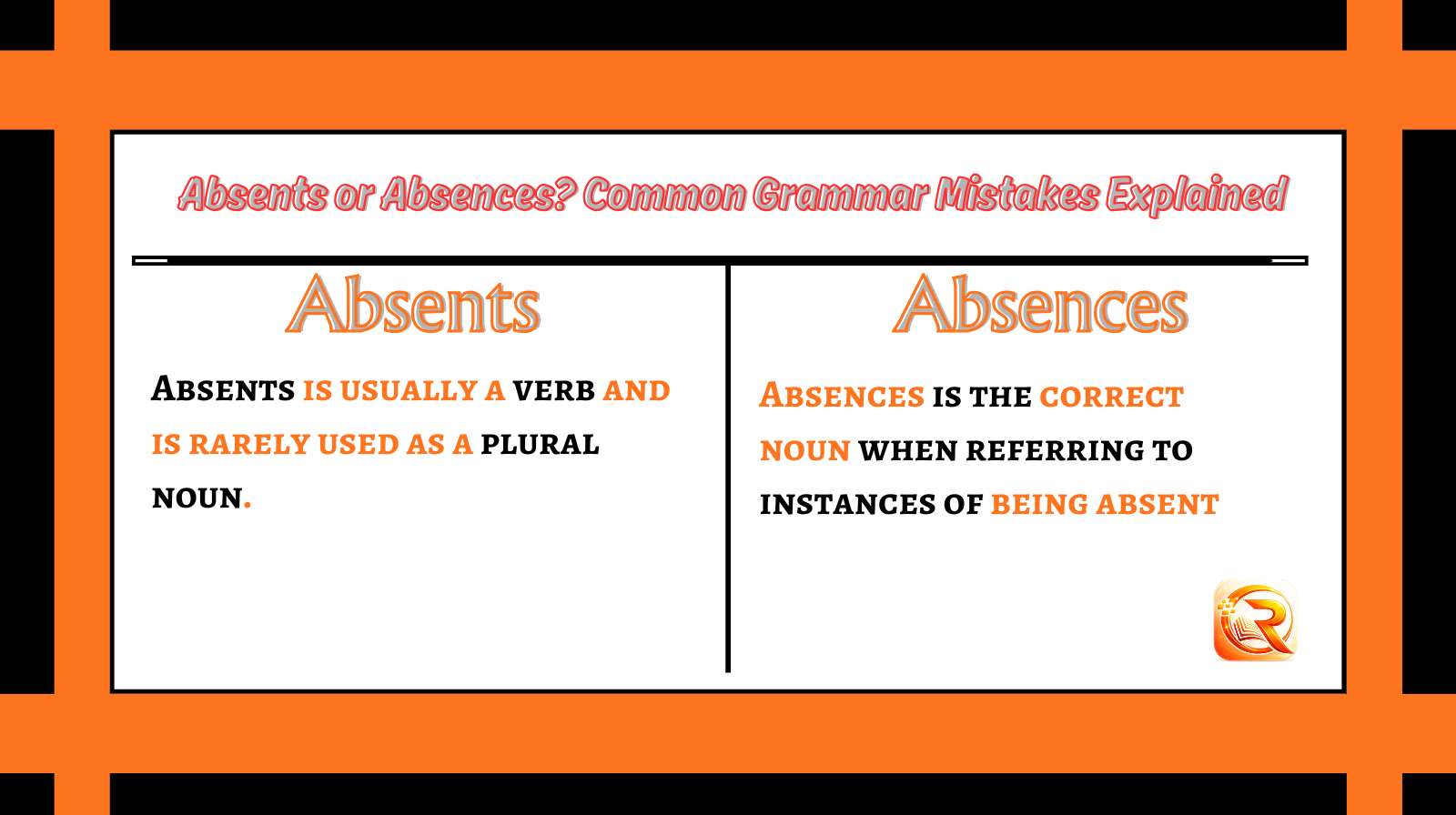
Absences is the correct noun when referring to instances of being absent. Absents is usually a verb and is rarely used as a plural noun.
Although the difference looks small, choosing the wrong word can make your writing sound unnatural or grammatically incorrect. In this guide, you’ll learn what each word means, when to use it, why people confuse them, and how to avoid this common grammar mistake forever.
Featured Snippet: Absents or Absences?
“Absences” is the correct plural noun referring to occasions when someone is not present. “Absents” is primarily the third-person singular form of the verb “absent,” meaning to stay away or remove oneself. In most writing, use “absences” instead of “absents.”
What Does “Absences” Mean?
The word absences is the plural form of absence.
An absence means the state of being away from a place, event, school, work, or activity when someone is expected to be there.
Absence Definition
Absence (noun):
The condition of not being present where someone or something is expected.
Examples of “Absences”
- The teacher recorded three absences this week.
- Frequent absences can affect academic performance.
- His repeated absences worried his manager.
- The company has reduced employee absences through flexible work policies.
- Several absences were reported during the morning meeting.
Notice that absences refers to events or records of being absent not the people themselves.
What Does “Absents” Mean?
Unlike absences, the word absents is generally a verb, not a noun.
It comes from the verb to absent, which means:
- to stay away intentionally
- to remove oneself from a place
Verb Definition
Absent (verb):
To deliberately stay away from somewhere.
Examples
- He absents himself from unnecessary meetings.
- She often absents herself during office celebrations.
- The student absents himself without informing the teacher.
While grammatically correct, this verb is relatively formal and uncommon in everyday English. Most native speakers simply say:
- He is absent from school.
- She missed the meeting.
- They didn’t attend class.
Is “Absents” Ever Used as a Plural Noun?
This is where many learners get confused.
People sometimes hear teachers say:
“There are five absents today.”
Although this expression appears in some classrooms and regions, especially in informal spoken English, it is not considered standard English grammar.
Instead, standard English uses:
- Five students are absent.
- There are five absences recorded today.
- Five students were missing today.
Incorrect
❌ There were ten absents today.
Correct
✅ There were ten absences recorded today.
OR
✅ Ten students were absent today.
Absents vs. Absences: Key Differences
| Feature | Absents | Absences |
|---|---|---|
| Part of speech | Verb | Noun |
| Meaning | Stays away intentionally | Instances of being absent |
| Common usage | Rare | Very common |
| Used in attendance records | No | Yes |
| Standard English | Limited | Yes |
Quick Rule
If you’re talking about attendance records, always choose absences.
If you’re talking about someone deliberately staying away, absents may be used as a verb.
Why Do People Confuse These Words?
There are several reasons this mistake is so common.
1. Similar Spellings
Both words begin with absent, making them appear interchangeable.
2. Classroom Habits
Some schools informally refer to missing students as absents, even though standard grammar prefers absences or students who are absent.
3. Influence of Other Languages
Many languages use a single word for both the person and the event of being absent, causing English learners to transfer that pattern.
4. Automatic Translation Tools
Some translation tools suggest literal equivalents that sound unnatural in English, leading learners to adopt incorrect usage.
When Should You Use “Absences”?
Use absences whenever you’re referring to:
- attendance records
- missed classes
- missed workdays
- periods of nonattendance
- official reports
Examples
School
- Too many absences may lower your final grade.
Work
- HR monitors employee absences each month.
Medical
- Frequent absences can indicate underlying health issues.
Sports
- Player absences affected the team’s performance.
When Should You Use “Absents”?
Use absents only when it’s functioning as a verb.
Examples
- He absents himself whenever conflict arises.
- She absents herself from political discussions.
- The employee repeatedly absents himself without permission.
In everyday conversation, these are much less common than simpler alternatives like:
- skips
- misses
- avoids
- doesn’t attend
Common Grammar Mistakes
Many writers accidentally replace absences with absents.
Mistake 1
❌ The school reported fifteen absents.
✅ The school reported fifteen absences.
Mistake 2
❌ Too many absents hurt your attendance.
✅ Too many absences hurt your attendance.
Mistake 3
❌ Our class has three absents today.
✅ Three students are absent today.
OR
✅ Our class has three recorded absences today.
Real Sentence Comparison
Correct:
- The company tracks employee absences carefully.
- His repeated absences raised concerns.
- She absents herself from social events.
Incorrect:
- The company tracks employee absents.
- We had six absents yesterday.
- His absents caused problems.
These incorrect forms sound unnatural because absents is being used where a noun is required.
Common Contexts Where “Absences” Is Used
You’ll frequently encounter absences in:
- Schools
- Colleges
- Universities
- Human Resources
- Employee attendance systems
- Payroll records
- Medical leave reports
- Legal attendance documentation
Because these fields rely on precise language, absences is the accepted standard. Grammar authorities consistently distinguish absence (noun) from absent (adjective/verb), and learner resources note that confusing related word forms is a common source of mistakes.
Real-Life Case Study: Why Using “Absences” Matters
Imagine a high school teacher preparing the monthly attendance report for the principal. While entering the records, the teacher writes:
“The class had 18 absents this month.”
Although many readers understand the intended meaning, the sentence is not grammatically correct because absents is being used as a plural noun instead of a verb.
The correct sentence is:
“The class had 18 absences this month.”
This small correction makes the report more professional and aligns with standard English grammar. The same rule applies in workplaces, universities, hospitals, and government offices where attendance records are maintained. Official documents almost always use absence or absences because they refer to recorded instances of someone not being present.
Suppose an HR manager is reviewing attendance data for employees. Writing “employee absents” could create confusion, while “employee absences” clearly refers to the number of missed workdays. Precise wording improves communication, reduces misunderstandings, and reflects professionalism in formal writing.
The lesson is simple: when discussing attendance records or missed days, choose absences. Reserve absents only for its rare use as a verb, such as “He absents himself from meetings.”
Attendance and Absence Statistics (2025–2026)
Although this article focuses on grammar rather than attendance management, real-world data shows why the word absences is so common in education and workplaces.
- A 2025 workplace wellbeing report from the Chartered Institute of Personnel and Development (CIPD) found that the average employee absence reached 9.4 days per employee annually, the highest level recorded in the survey’s history.
- Gallup’s State of the Global Workplace 2026 (based on 2025 data) continues to track employee attendance, engagement, and workplace wellbeing, highlighting why organizations closely monitor employee absences.
These reports consistently use the noun absence or absences, reinforcing that this is the accepted terminology in professional English.
How to Choose Between “Absents” and “Absences”
Follow these simple steps whenever you’re unsure.
Step 1: Are You Talking About Missed Days?
If yes, use absences.
Example:
- The student has five absences this semester.
Step 2: Are You Describing Someone Staying Away?
If yes, you may use absents as a verb.
Example:
- He absents himself from meetings.
Step 3: Is It an Attendance Report?
Always use absences.
Examples:
- Employee absences
- School absences
- Attendance absences
- Medical absences
Step 4: Would “Missing Students” Sound Better?
If you’re referring to people rather than records, rewrite the sentence.
Instead of:
❌ We have four absents today.
Write:
✅ Four students are absent today.
Memory Trick
A quick way to remember the difference is:
- Absence = Event (a missed day or period)
- Absent = Description (someone is not present)
- Absents = Action (someone deliberately stays away)
If you mean a record of missing attendance, the answer is almost always absences.
Related Grammar Mistakes
If you often confuse absents and absences, you may also find these word pairs tricky:
- Affect vs. Effect
- Advice vs. Advise
- Than vs. Then
- Accept vs. Except
- Its vs. It’s
- Principal vs. Principle
- Lose vs. Loose
These mistakes usually happen because the words look or sound similar but belong to different parts of speech.
Mini Quiz: Test Your Knowledge About Absents or Absences
Test your understanding of Absents or Absences with these quick and engaging questions.
- The teacher recorded three ________ this week.
- Too many ________ can affect your final grade.
- He often ________ himself from unnecessary meetings.
- The company tracks employee ________ every month.
- Sarah ________ herself from social events.
- Frequent ________ may lead to attendance warnings.
- The principal reviewed all student ________ before the meeting.
- The employee ________ himself without informing his manager.
- There were five recorded ________ in the attendance register.
- His repeated ________ worried his teachers.
- She rarely ________ herself from important conferences.
- School ________ are carefully monitored each semester.
- Multiple ________ may affect an employee’s performance review.
- He ________ himself whenever difficult discussions begin.
- Medical ________ should be supported with proper documentation.
- The coach explained that too many ________ could reduce playing time.
- An official attendance report should use the word ________, not “absents.”
- The verb absents means someone deliberately ________ themselves from a place.
- In formal English, “The class had ten ________ this month” is the correct sentence.
- When referring to attendance records, always choose ________ instead of “absents.”
Quiz Answers
- absences
- absences
- absents
- absences
- absents
- absences
- absences
- absents
- absences
- absences
- absents
- absences
- absences
- absents
- absences
- absences
- absences
- removes
- absences
- absences
References
For additional guidance on English spelling and grammar, consult these authoritative resources:
Frequently Asked Questions
Q: Is “absents” grammatically correct?
Yes, but only as a verb. For example, He absents himself from meetings. It is not the standard plural noun for attendance records.
Q: Which is correct: absents or absences?
When referring to missed classes, workdays, or attendance records, absences is correct.
Q: Can I say “three absents today”?
In informal speech, some people do. However, standard English prefers:
- Three students are absent today.
- Three absences were recorded today.
Q: Why do schools use the word “absence”?
Because an absence refers to a recorded instance of someone not being present. It is the correct noun used in attendance systems.
Q: Is “absence” a noun or an adjective?
Absence is a noun.
Example:
- Her absence was noticed immediately.
Q: Is “absent” a noun?
No. Absent is usually an adjective and can also function as a verb in formal English.
Q: What is the plural of “absence”?
The plural form is absences.
Q: How can I remember the difference?
Remember this rule:
- Absence/Absences = Records or events
- Absent = Not present
- Absents = Verb meaning to stay away
Conclusion
Understanding the difference between absents and absences is easier once you know their grammatical roles. Absences is the correct noun for referring to missed classes, workdays, meetings, or any recorded instance of not being present. Absents, on the other hand, is primarily a verb meaning to stay away intentionally and is used far less often in everyday English.
Whenever you’re writing an attendance report, school document, workplace email, or formal article, choose absences for clarity and correctness. Doing so will make your writing sound more natural, professional, and grammatically accurate.
The next time you hesitate between absents or absences, remember one simple rule:
Use “absences” for attendance records. Use “absents” only as a verb.
Mastering small grammar differences like this can greatly improve your writing confidence. Keep practicing, and you’ll avoid this common English mistake every time.
Keep learning with more easy grammar lessons on Rule Scoope

I’m Bilal SEO Expert, the creator of RuleScoope, where I publish grammar guides and explain confusing words to help readers communicate clearly and confidently in English.