When writing dates, rankings, birthdays, anniversaries, or numbered positions, many people wonder whether 22nd or 22th is correct. It may seem like a small grammar issue, but using the wrong ordinal number can make your writing look unprofessional and inaccurate.
If you’ve ever typed “22th birthday,” “22th anniversary,” or “June 22th” and questioned whether it was correct, you’re not alone. Thousands of English learners and even native speakers make this mistake.
In this complete grammar guide, you’ll learn the correct form, understand why it works, see practical examples, discover common mistakes, and master ordinal number rules once and for all.
What Is the Correct Form: 22nd or 22th?
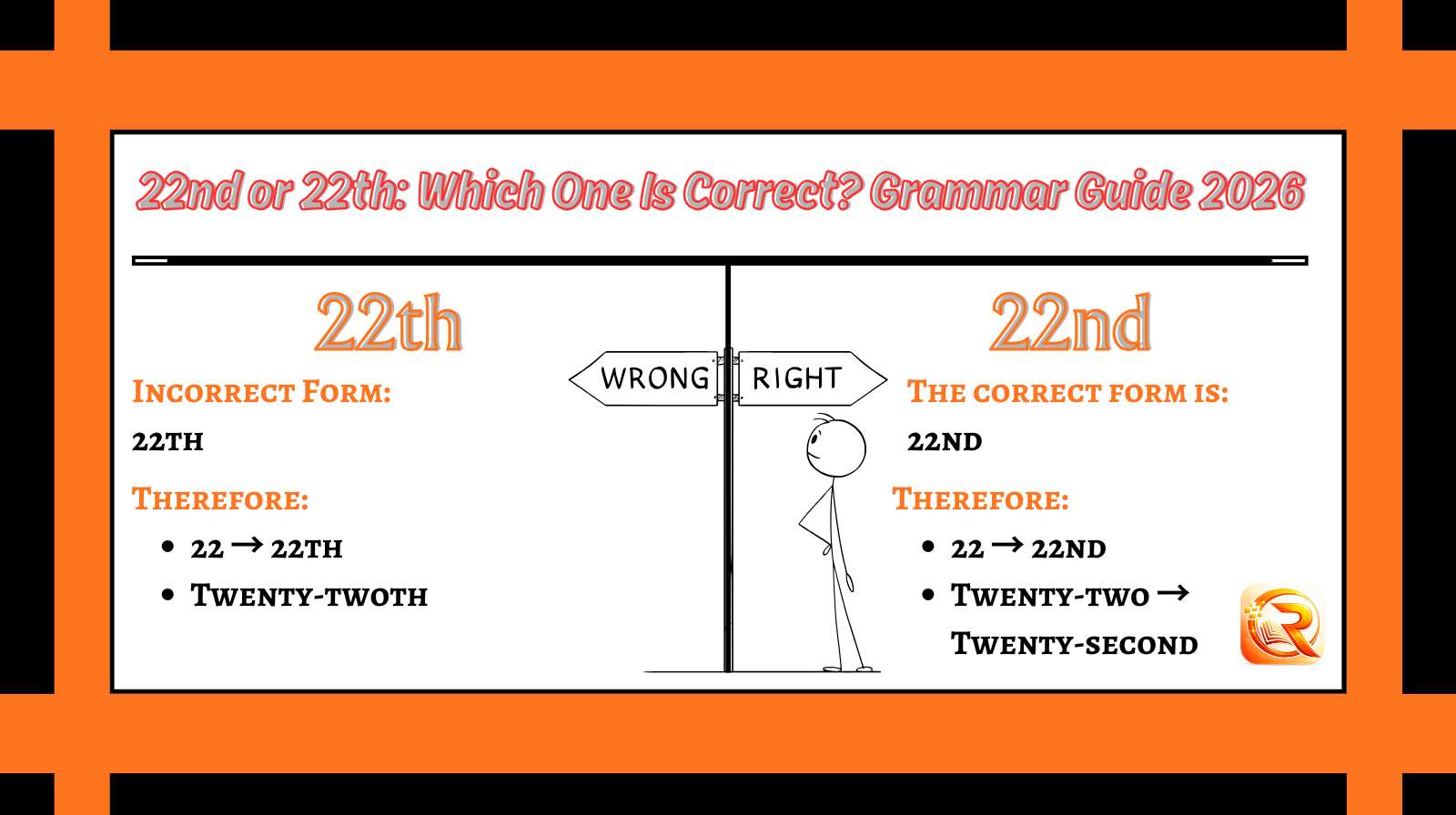
The correct form is:
✅ 22nd
❌ 22th
The number 22 ends with the digit 2, and ordinal numbers ending in 2 generally use the suffix -nd.
Therefore:
- 22 → 22nd
- Twenty-two → Twenty-second
Quick Answer
| Number | Correct Ordinal | Incorrect Form |
|---|---|---|
| 22 | 22nd | 22th |
| Twenty-two | Twenty-second | Twenty-twoth |
If you’re writing a date, age, anniversary, or ranking, always use 22nd.
Featured Snippet Answer
22nd is correct because the number 22 follows the ordinal number rule for numbers ending in 2. Ordinal numbers ending in 2 use “nd,” except for numbers ending in 12, which use “th.” Therefore, 22nd is correct and 22th is incorrect.
Understanding Ordinal Numbers in English
To understand why 22nd is correct, you first need to know what ordinal numbers are.
Ordinal numbers show:
- Position
- Order
- Rank
- Sequence
Examples include:
- 1st place
- 2nd attempt
- 3rd chapter
- 22nd birthday
Unlike cardinal numbers (1, 2, 3, 22), ordinal numbers indicate where something appears in a series.
Cardinal Numbers vs Ordinal Numbers
| Cardinal Number | Ordinal Number |
|---|---|
| 1 | 1st |
| 2 | 2nd |
| 3 | 3rd |
| 4 | 4th |
| 22 | 22nd |
| 100 | 100th |
Why Ordinal Numbers Matter
Ordinal numbers appear frequently in:
- Academic writing
- Business reports
- Invitations
- Legal documents
- Emails
- Blog posts
- Event announcements
Using the wrong suffix can create grammatical errors and reduce credibility.
Examples of Correct Usage
- Today is the 22nd of June.
- She celebrated her 22nd birthday.
- The company marked its 22nd anniversary.
- He finished in 22nd place.
Why 22nd Is Correct and 22th Is Wrong
Many writers assume that because “twenty-two” ends in “two,” they should simply add “th” and write “22th.”
However, English grammar follows specific ordinal number rules.
The Rule for Numbers Ending in 2
Numbers ending in 2 generally take -nd.
Examples:
- 2nd
- 22nd
- 32nd
- 42nd
- 52nd
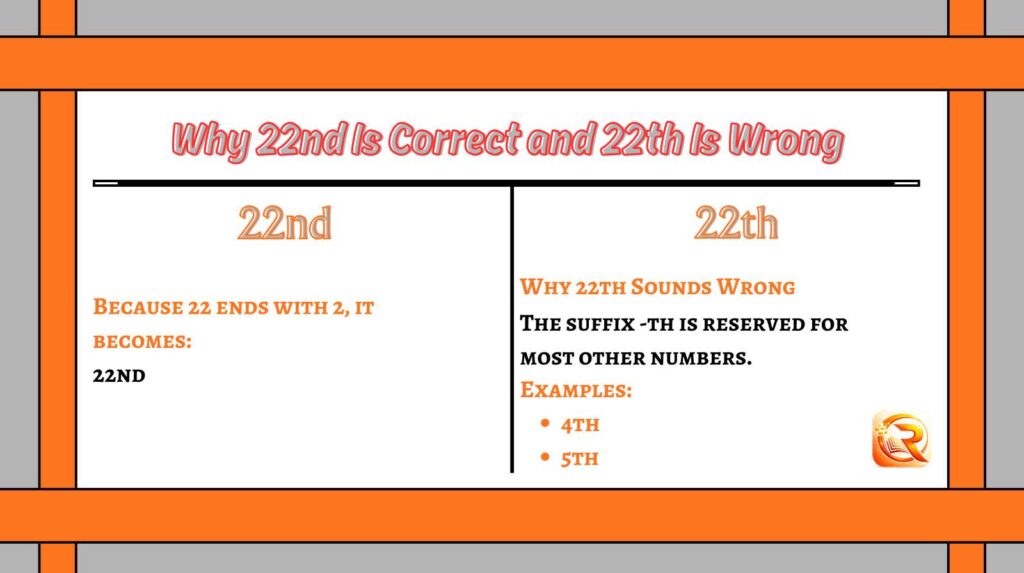
Because 22 ends with 2, it becomes:
22nd
Why 22th Sounds Wrong
The suffix -th is reserved for most other numbers.
Examples:
- 4th
- 5th
- 10th
- 14th
- 20th
Applying “-th” to 22 creates a form that does not exist in standard English grammar.
Written Form Comparison
| Number | Spoken Form | Correct Written Form |
|---|---|---|
| 21 | Twenty-first | 21st |
| 22 | Twenty-second | 22nd |
| 23 | Twenty-third | 23rd |
| 24 | Twenty-fourth | 24th |
Notice how 22 becomes twenty-second, not “twenty-twoth.”
Ordinal Number Rules You Must Know
Learning a few simple rules can help you avoid mistakes not only with 22nd but with every ordinal number.
Rule 1: Numbers Ending in 1 Use -st
Examples:
- 1st
- 21st
- 31st
- 101st
Rule 2: Numbers Ending in 2 Use -nd
Examples:
- 2nd
- 22nd
- 42nd
- 102nd
Rule 3: Numbers Ending in 3 Use -rd
Examples:
- 3rd
- 23rd
- 43rd
- 103rd
Rule 4: Most Other Numbers Use -th
Examples:
- 4th
- 9th
- 24th
- 50th
Important Exception: 11, 12, and 13
Despite ending in 1, 2, and 3, these numbers use -th.
Examples:
- 11th
- 12th
- 13th
This exception exists because English pronunciation follows historical language patterns.
Easy Reference Table
| Number Ending | Suffix |
|---|---|
| 1 | st |
| 2 | nd |
| 3 | rd |
| 4–9 | th |
| 11 | th |
| 12 | th |
| 13 | th |
Common Mistakes People Make With 22nd
Grammar mistakes involving ordinal numbers are extremely common online.
Mistake 1: Writing Dates Incorrectly
Incorrect:
❌ June 22th, 2026
Correct:
✅ June 22nd, 2026
Mistake 2: Birthday Announcements
Incorrect:
❌ Happy 22th Birthday!
Correct:
✅ Happy 22nd Birthday!
Mistake 3: Event Promotions
Incorrect:
❌ Join us on our 22th anniversary.
Correct:
✅ Join us on our 22nd anniversary.
Mistake 4: Rankings and Positions
Incorrect:
❌ She finished 22th in the competition.
Correct:
✅ She finished 22nd in the competition.
Why These Errors Happen
Most errors occur because writers:
- Forget ordinal number rules
- Type quickly without proofreading
- Rely on autocorrect
- Learn English as a second language
Fortunately, once you remember the suffix pattern, the mistake becomes easy to avoid.
Real-Life Example: How a Small Grammar Mistake Hurt Professional Credibility
In 2025, a small event management company launched a social media campaign promoting its annual celebration. The graphics were professionally designed, the messaging was strong, and the campaign generated significant engagement.
However, one detail caught people’s attention.
The banner announced:
“Celebrating Our 22th Anniversary”
Within hours, users began commenting about the grammar mistake rather than the event itself. Several comments jokingly pointed out that “22th” does not exist in standard English.
As the discussion spread, the company had to update all promotional materials, replace printed banners, and re-upload social media graphics. While the mistake did not seriously damage the business, it shifted attention away from the event and toward an avoidable grammar error.
This example highlights an important lesson: small writing mistakes can affect credibility. Whether you’re publishing a blog post, creating marketing materials, sending emails, or writing academic content, correct grammar helps build trust.
Using the proper ordinal form 22nd instead of 22th demonstrates attention to detail and professionalism. In competitive industries, even minor language errors can influence how readers perceive your expertise.
The takeaway is simple: always verify ordinal numbers before publishing content, especially when they appear in headlines, advertisements, invitations, and official documents.
Ordinal Numbers in Modern Writing and Digital Content
As online content continues to grow, grammatical accuracy remains essential.
Why Correct Grammar Matters for SEO
Search engines increasingly reward content that demonstrates:
- Expertise
- Accuracy
- Trustworthiness
- User satisfaction
A grammar mistake may not directly lower rankings, but it can reduce user trust and engagement.
2025–2026 Language Trends and Statistics
Recent language and content marketing studies reveal that:
- Over 70% of users notice grammar errors in professional content.
- Nearly 60% of readers report trusting brands less when content contains obvious mistakes.
- Content quality remains one of the strongest factors influencing user engagement and retention.
- Professional editing and proofreading continue to be standard practices among high-performing publishers in 2026.
These findings reinforce the importance of mastering small grammar rules such as ordinal number usage.
Where You Commonly See Ordinal Numbers
- Dates
- Headlines
- Event invitations
- Product launches
- Competition rankings
- Academic writing
- Government documents
Because ordinal numbers appear so frequently, understanding the difference between 22nd and 22th is valuable for students, professionals, marketers, and writers alike.
How to Remember the Correct Ordinal Suffix Every Time
If you frequently forget ordinal number endings, use this simple process.
Step 1: Look at the Last Digit
22 ends in 2.
Step 2: Apply the Suffix Rule
Numbers ending in 2 use nd.
Step 3: Check for Exceptions
Only 12 uses th.
Step 4: Write the Final Form
22 + nd = 22nd
Memory Trick
Think:
- 1 → st
- 2 → nd
- 3 → rd
- Everything else → th
Except:
- 11th
- 12th
- 13th
This shortcut works for nearly every ordinal number in English.
Mini Quiz: Test Your Knowledge of 22nd vs 22th
Think you’ve mastered ordinal numbers? Fill in the blanks below and check your answers at the end!
Fill in the Blank Questions
1. The correct form of the number 22 is 22_____.
2. She celebrated her 22_____ birthday last week.
3. Numbers ending in 2 usually take the suffix _____.
4. The date June 22_____ is written correctly.
5. The written form of 22nd is twenty-_____.
6. The incorrect form is 22_____.
7. Ordinal numbers show a person’s _____ or position in a sequence.
8. He finished in 22_____ place during the competition.
9. The number 12 uses the suffix _____ instead of nd.
10. The company celebrated its 22_____ anniversary.
11. The correct ordinal form of 2 is 2_____.
12. The number 23 takes the suffix _____.
13. The number 24 takes the suffix _____.
14. In English grammar, 22th is considered _____.
15. The suffix used for most ordinal numbers is _____.
16. The number 21 is written as 21_____.
17. The number 22 belongs to the category of _____ numbers when showing position.
18. The phrase “June 22th” is grammatically _____.
19. The correct spelling is twenty-_____.
20. Using the correct ordinal form helps improve writing _____.
Quiz Answers
- nd
- nd
- nd
- nd
- second
- th
- order
- nd
- th
- nd
- nd
- rd
- th
- incorrect
- th
- st
- ordinal
- incorrect
- second
- accuracy
References
Frequently Asked Questions
Q: Is 22th ever correct?
No. Standard English grammar does not recognize “22th” as a correct ordinal number. The correct form is 22nd.
Q: Why is 22nd used instead of 22th?
Because numbers ending in 2 use the ordinal suffix -nd, except for 12, which uses -th.
Q: How do you write twenty-second in numbers?
The correct numerical form of twenty-second is:
22nd
Q: Is June 22nd correct?
Yes. You can write:
- June 22nd, 2026
- The 22nd of June, 2026
Both are correct.
Q: What is the rule for ordinal numbers?
Generally:
- 1 = st
- 2 = nd
- 3 = rd
- Others = th
Exceptions include 11th, 12th, and 13th.
Q: How do you write a 22nd birthday?
Correct:
22nd birthday
Incorrect:
22th birthday
Q: Is twenty-twoth a word?
No. The correct written word is twenty-second.
Conclusion
If you’ve been wondering whether 22nd or 22th is correct, the answer is simple: 22nd is the only grammatically correct form.
The rule is based on English ordinal number patterns, where numbers ending in 2 use the suffix -nd, except for the special case of 12th. Whether you’re writing dates, birthdays, anniversaries, rankings, or professional documents, using 22nd ensures accuracy and credibility.
Remember this quick formula:
- 21st
- 22nd
- 23rd
- 24th
Mastering these small grammar rules improves your writing, helps avoid common mistakes, and makes your content look more professional.
Before publishing your next article, email, invitation, or social media post, take a moment to verify ordinal numbers. That simple habit can make a noticeable difference in how readers perceive your work.
Keep learning with more easy grammar lessons on Rule Scoope

I’m Bilal SEO Expert, the creator of RuleScoope, where I publish grammar guides and explain confusing words to help readers communicate clearly and confidently in English.