Have you ever typed “writting” and wondered whether your spell checker was wrong or if you were? You’re not alone. Thousands of English learners and even experienced writers make this spelling mistake every day because English spelling rules aren’t always obvious.
The confusion usually happens because many English words double their final consonant before adding -ing, while others don’t. Without knowing the underlying rule, it’s easy to assume that writting follows the same pattern.
The good news is that the answer is straightforward once you understand the grammar behind it.
In this guide, you’ll learn:
- Which spelling is correct
- Why one version is incorrect
- The grammar rule behind the spelling
- Easy tricks to remember it
- Real-life examples
- Common mistakes to avoid
- Expert writing tips to improve your English
By the end, you’ll never confuse writing or writting again.
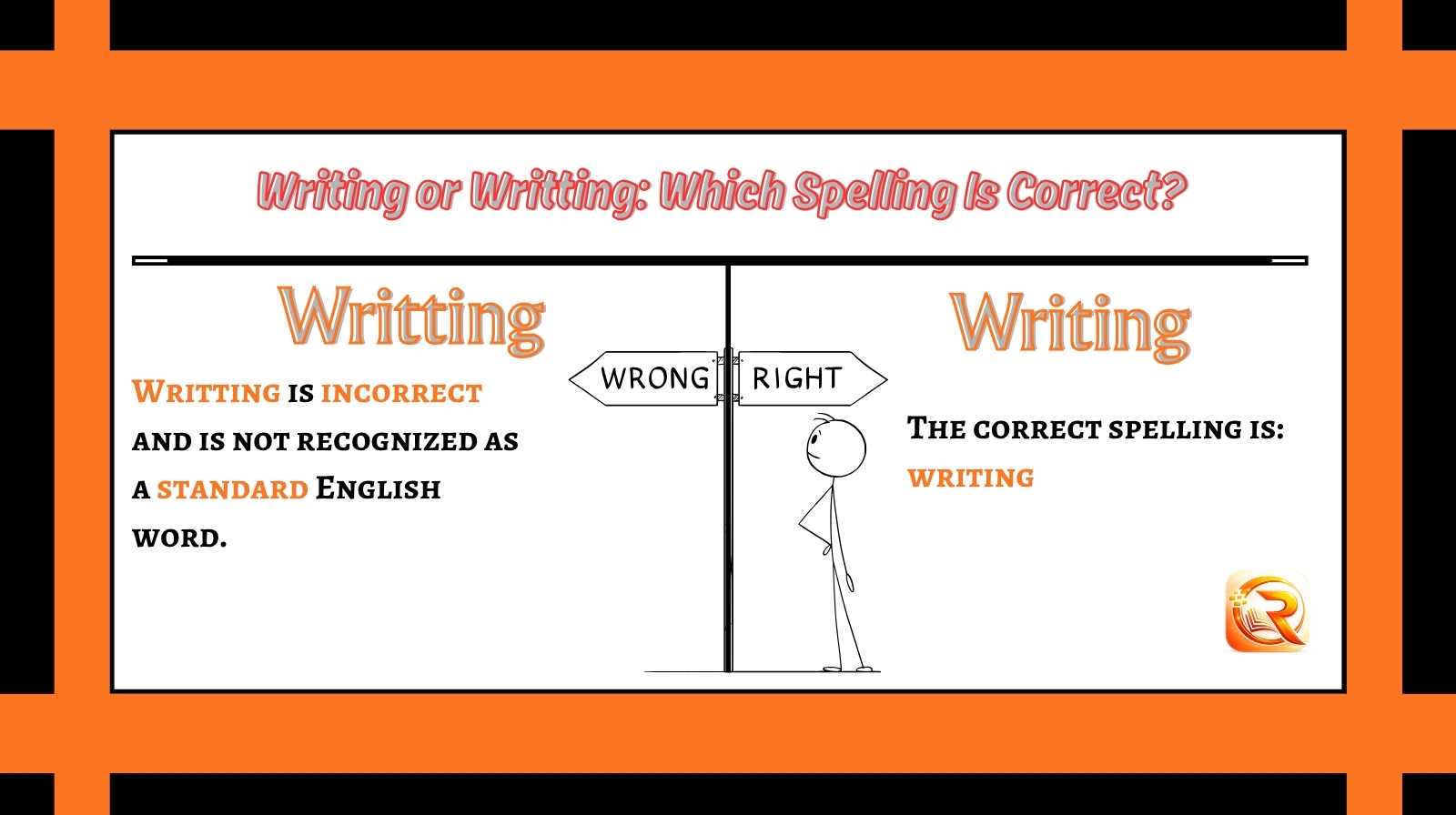
Writing or Writting: Which Spelling Is Correct?
The correct spelling is writing.
❌ Writting is incorrect and is not recognized as a standard English word.
| Spelling | Correct? | Explanation |
|---|---|---|
| Writing | ✅ Yes | Correct present participle and gerund of write. |
| Writting | ❌ No | Incorrect spelling caused by unnecessarily doubling the letter t. |
Quick Answer
If you’re writing an email, essay, report, article, or social media post, always use writing.
Correct examples:
- She is writing a novel.
- I enjoy writing every morning.
- Good writing requires practice.
- He is writing a business proposal.
Incorrect examples:
- She is writting a novel.
- I love writting stories.
- His writting has improved.
Remember:
Writing is the only correct spelling in modern English.
What Does “Writing” Mean?
The word writing comes from the verb write.
It has two common uses.
Writing as a Verb
When used with -ing, it describes an action happening now.
Examples:
- She is writing a letter.
- They are writing an email.
- We are writing today’s lesson.
In these sentences, writing functions as the present participle.
Writing as a Noun
It can also refer to the activity or skill of expressing ideas through words.
Examples:
- Writing improves communication skills.
- Creative writing is my favorite subject.
- Academic writing requires careful research.
- Technical writing demands precision.
Because it works as both a verb and a noun, you’ll encounter writing frequently in everyday English.
Why Is “Writting” Incorrect?
Many people wonder why writing has only one t when words like running and sitting use two.
The answer lies in an important English spelling rule.
The base verb is:
write
Notice that it already ends with a silent e.
When adding -ing, English follows this rule:
Drop the silent e, then add -ing.
So the process becomes:
write
↓
remove e
↓
writing
There is no reason to double the t because write does not meet the consonant-doubling rule.
That is why:
- write → writing ✅
- write → writting ❌
The Silent “E” Rule
Many English verbs ending with a silent e follow exactly the same pattern.
| Base Verb | Correct -ing Form |
|---|---|
| write | writing |
| make | making |
| drive | driving |
| smile | smiling |
| dance | dancing |
| arrive | arriving |
| create | creating |
| move | moving |
Notice something?
Every word simply removes the silent e.
None of them doubles the final consonant.
Why People Add an Extra “T”
There are several reasons why this mistake is so common.
1. Confusing It with Double-Consonant Words
Words like:
- running
- sitting
- stopping
- swimming
all double their final consonant.
Many learners incorrectly assume write follows the same rule.
It doesn’t.
2. Pronunciation Confusion:
The pronunciation of writing sometimes makes the t sound stronger than expected.
Some learners assume that a stronger sound means another t should appear in spelling.
English spelling doesn’t work that way.
3. Typing Too Quickly:
Professional editors often notice that writting appears simply because someone typed too quickly.
Spell-check software usually catches it immediately.
However, relying entirely on spell-check isn’t the best habit.
Understanding the grammar rule helps you avoid the mistake naturally.
Read More: Leafs or Leaves: Which Is Correct? Grammar Guide (2026)
The English Spelling Rule Behind “Writing”
Understanding one simple rule will help you spell hundreds of English words correctly.
Rule 1: Drop the Silent “E”
When a verb ends in a silent e, remove it before adding -ing.
Examples:
| Verb | Correct Form |
|---|---|
| write | writing |
| hope | hoping |
| love | loving |
| move | moving |
| bake | baking |
| arrive | arriving |
This is exactly what happens with writing.
Rule 2: Double the Final Consonant Only When Required
A consonant is doubled only if all of these conditions are true:
- The word has one syllable (or the stress is on the last syllable).
- It ends with one vowel followed by one consonant.
- The final consonant isn’t w, x, or y.
Examples:
| Base Word | Correct Form |
|---|---|
| run | running |
| stop | stopping |
| sit | sitting |
| swim | swimming |
| plan | planning |
Now compare that with write.
It ends with a silent e, so a completely different rule applies.
Therefore:
- write → writing ✅
- run → running ✅
Different rules produce different spellings.
Common Examples Using “Writing”
Here are examples from everyday English.
At School
- She is writing an essay.
- The teacher praised his writing skills.
- Students spend an hour writing every morning.
At Work
- I’m writing today’s report.
- She’s writing an important proposal.
- Writing professional emails takes practice.
At Home
- My daughter enjoys writing stories.
- He spends weekends writing poems.
- Writing a journal helps reduce stress.
Online
- Writing blog posts requires research.
- She’s writing content for her website.
- Writing social media captions takes creativity.
Every one of these examples uses writing, never writting.
Quick Memory Trick
Whenever you’re unsure, remember this simple phrase:
Write loses E before adding ING.
Think of it as:
Write
− E
+ ING

= Writing
There is never an extra t.
This simple memory trick can save you from one of the most common spelling mistakes in English.
Read More: Chello or Cello: Which Spelling Is Correct? (Grammar Guide 2026)
Common Mistakes People Make with “Writing”
Even fluent English speakers occasionally make spelling mistakes, especially when typing quickly. Below are some of the most common errors related to writing and how to avoid them.
Mistake 1: Adding an Extra “T”
❌ Writting
✅ Writing
This is by far the most frequent mistake. Remember, write follows the silent e rule not the double-consonant rule.
Mistake 2: Confusing “Writing” with “Written”
Although both words come from the verb write, they serve different grammatical purposes.
| Word | Part of Speech | Example |
|---|---|---|
| Writing | Present participle / Gerund | She is writing a letter. |
| Written | Past participle | The letter was written yesterday. |
Mistake 3: Relying Only on Spell Check
Spell-check tools are helpful, but they don’t teach grammar. Understanding spelling rules helps you write confidently, even without software assistance.
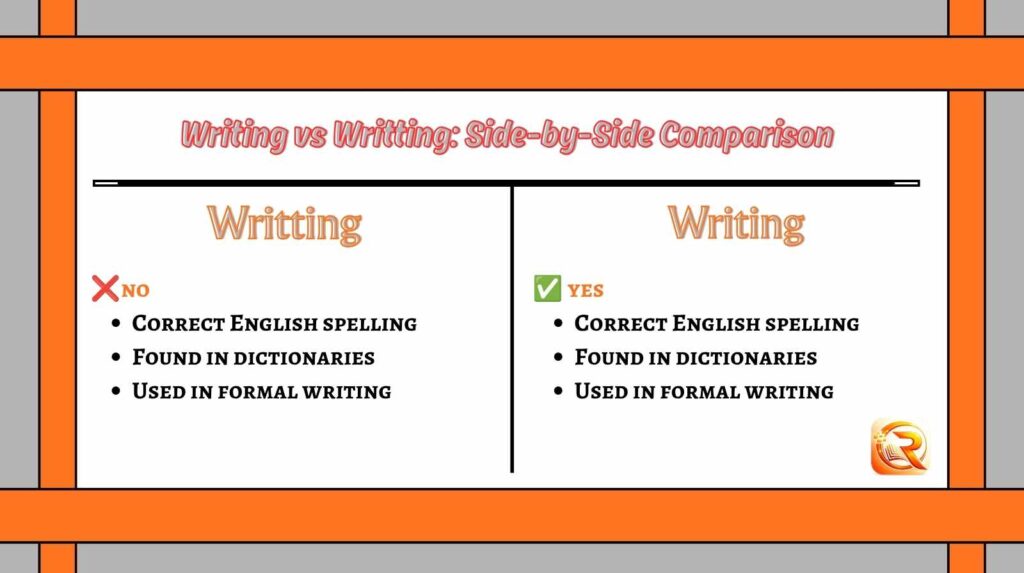
Writing vs Writting: Side-by-Side Comparison
| Feature | Writing | Writting |
|---|---|---|
| Correct English spelling | ✅ Yes | ❌ No |
| Found in dictionaries | ✅ Yes | ❌ No |
| Used in formal writing | ✅ Yes | ❌ Never |
| Used in academic papers | ✅ Yes | ❌ No |
| Accepted in business communication | ✅ Yes | ❌ No |
| Recommended by grammar experts | ✅ Yes | ❌ No |
Featured Snippet Answer
Is it writing or writting?
The correct spelling is writing. The word comes from the verb write, which drops its silent e before adding -ing. Writting is a misspelling and should never be used in standard English.
Real-Life Example: How One Small Spelling Mistake Changed a First Impression
Imagine a university student applying for a competitive internship. They spend hours preparing a professional résumé and writing a thoughtful cover letter. Everything looks polished until the recruiter notices a sentence that reads:
“I enjoy writting technical documentation and blog articles.”
Although the applicant has excellent qualifications, the misspelled word immediately catches the recruiter’s attention. In roles that require strong communication skills, even a simple spelling error can raise concerns about attention to detail.
After receiving feedback, the student reviewed common English spelling rules and learned that write drops its silent e before adding -ing. They corrected the mistake, updated all application materials, and began proofreading every document before submitting it.
A few weeks later, they successfully secured interviews with multiple companies. While one spelling correction wasn’t the only reason for their success, it helped present a more professional image.
This example highlights an important lesson: small spelling mistakes can influence how others perceive your work. Whether you’re writing emails, essays, blog posts, or job applications, using the correct spelling demonstrates care, credibility, and professionalism.
Read More: Quizes or Quizzes: Which Spelling Is Correct?
Writing in Everyday Situations
You’ll use the word writing in many contexts.
Academic Writing
Students frequently encounter the word in assignments, essays, research papers, and examinations.
Examples:
- Writing skills improve with practice.
- Academic writing requires clear evidence.
- Good writing follows proper grammar.
Business Writing
Professional communication depends on accurate spelling.
Examples:
- She is writing today’s project report.
- We’re writing a proposal for the client.
- Writing effective emails saves time.
Creative Writing
Authors, bloggers, and storytellers use writing to express ideas creatively.
Examples:
- Creative writing develops imagination.
- He enjoys writing short stories.
- Daily writing builds confidence.
Digital Writing
Modern communication includes:
- Blog writing
- Website writing
- SEO writing
- Email writing
- Social media writing
- Technical writing
No matter the context, the spelling remains writing.
Read More: Amount or Ammount: Which Spelling Is Correct? (2026 Guide)
2025–2026 Data: Why Correct Spelling Still Matters
Although AI-assisted writing tools and grammar checkers have become more advanced, spelling accuracy continues to play an important role in education and professional communication.
Recent trends from major language and workplace platforms indicate:
- Millions of people use spelling and grammar assistance tools every day to improve written communication.
- Employers continue to rank written communication among the most valuable workplace skills.
- Search engines increasingly reward high-quality, well-written content that demonstrates expertise and trustworthiness.
- Educational institutions emphasize spelling and grammar as core components of writing proficiency.
These trends reinforce a simple reality: mastering common spelling rules such as knowing the difference between writing or writting helps improve clarity, professionalism, and reader trust.
Tips to Remember the Correct Spelling
Follow these simple tips whenever you’re unsure.
- Remember that write ends with a silent e.
- Remove the e before adding -ing.
- Don’t add an extra t.
- Read your writing aloud during proofreading.
- Use a trusted dictionary if you’re uncertain.
- Practice commonly confused English words.
- Build a habit of reviewing important documents before sharing them.
A quick formula to remember:
Write
− e
+ ing
= Writing
Read More: Eaten or Aten: Which One Is Correct? Grammar Guide (2026)
Mini Quiz: Test Your Knowledge of Writing or Writting
Think you’ve mastered the difference between Writing or Writting? Try these fun fill-in-the-blank questions and check your answers below!
- The correct spelling is ______, not writting.
- She is ______ a letter to her friend.
- The verb write drops the silent ______ before adding -ing.
- Writting is considered a ______ spelling.
- Good ______ skills improve communication.
- We are ______ an English assignment today.
- Writing can be both a ______ and a noun.
- The sentence “I enjoy ______ stories” uses the correct spelling.
- Before adding -ing, remove the silent ______ from write.
- Professional emails require clear and accurate ______.
- The word writing contains only one letter ______.
- Students improve their English by practicing ______ every day.
- Spell-check tools can help, but learning grammar rules is still ______.
- Writing is accepted in both American and ______ English.
- The phrase “Creative ______” refers to storytelling and imaginative work.
- Never use ______ in formal English writing.
- The correct formula is write → remove e → add ______.
- Academic ______ requires proper grammar and organization.
- A resume with correct ______ creates a better first impression.
- Remember: writing is always the ______ spelling.
Quiz Answers
- writing
- writing
- e
- incorrect
- writing
- writing
- verb
- writing
- e
- writing
- t
- writing
- important
- British
- Writing
- writting
- ing
- writing
- spelling
- correct
External References
For additional guidance on English spelling and grammar, consult these trusted resources:
- Merriam-Webster Dictionary – https://www.merriam-webster.com/
- Cambridge Dictionary – https://dictionary.cambridge.org/
These references consistently recognize writing as the correct spelling.
Frequently Asked Questions
Q: Is “writing” or “writting” correct?
Writing is the correct spelling. Writting is a misspelling and is not accepted in standard English.
Q: Why doesn’t “writing” have two Ts?
Because the verb write ends with a silent e. English spelling rules require dropping the silent e before adding -ing, not doubling the t.
Q: Is “writting” ever acceptable?
No. It is considered incorrect in academic, professional, and everyday English.
Q: How do I remember the correct spelling?
Think of this rule:
Write → Remove E → Add ING → Writing
There is never an extra t.
Q: Does British English spell it differently?
No. Both British English and American English use writing.
Q: Is “writing” a noun or a verb?
It can be both.
- As a verb: She is writing a report.
- As a noun: Writing is an essential communication skill.
Conclusion
The debate between writing and writting has a clear answer: writing is the only correct spelling.
The confusion often comes from assuming every verb doubles its final consonant before adding -ing. However, write follows a different rule. Since it ends with a silent e, you simply remove the e and add -ing, resulting in writing.
Whenever you’re unsure, remember this simple formula:
Write → Remove E → Add ING = Writing
Whether you’re preparing a school assignment, publishing a blog post, sending a business email, or updating your résumé, using the correct spelling strengthens your credibility and makes your writing more professional.
The next time you see writting, you’ll know it’s incorrect and you’ll have the grammar knowledge to explain exactly why.
Keep learning with more easy grammar lessons on Rule Scoope

I’m Bilal SEO Expert, the creator of RuleScoope, where I publish grammar guides and explain confusing words to help readers communicate clearly and confidently in English.