English spelling can be confusing, especially when irregular verbs are involved. One common question many learners ask is “Eaten or Aten: Which One Is Correct?” At first glance, aten may seem like a logical spelling because the past tense of eat is ate. However, English grammar follows specific rules, and not every word that sounds correct actually exists.
If you’ve ever paused while writing a sentence like “I have aten lunch” or “I have eaten lunch,” you’re not alone. Thousands of students, writers, and English learners search for this answer every year because mixing up verb forms is one of the most common grammar mistakes.
This guide explains the difference between eaten and aten, why only one is correct, how the verb eat changes across tenses, and how to avoid making this mistake in everyday writing. By the end, you’ll confidently know which form to use and why it matters.
What Is the Difference Between Eaten and Aten?
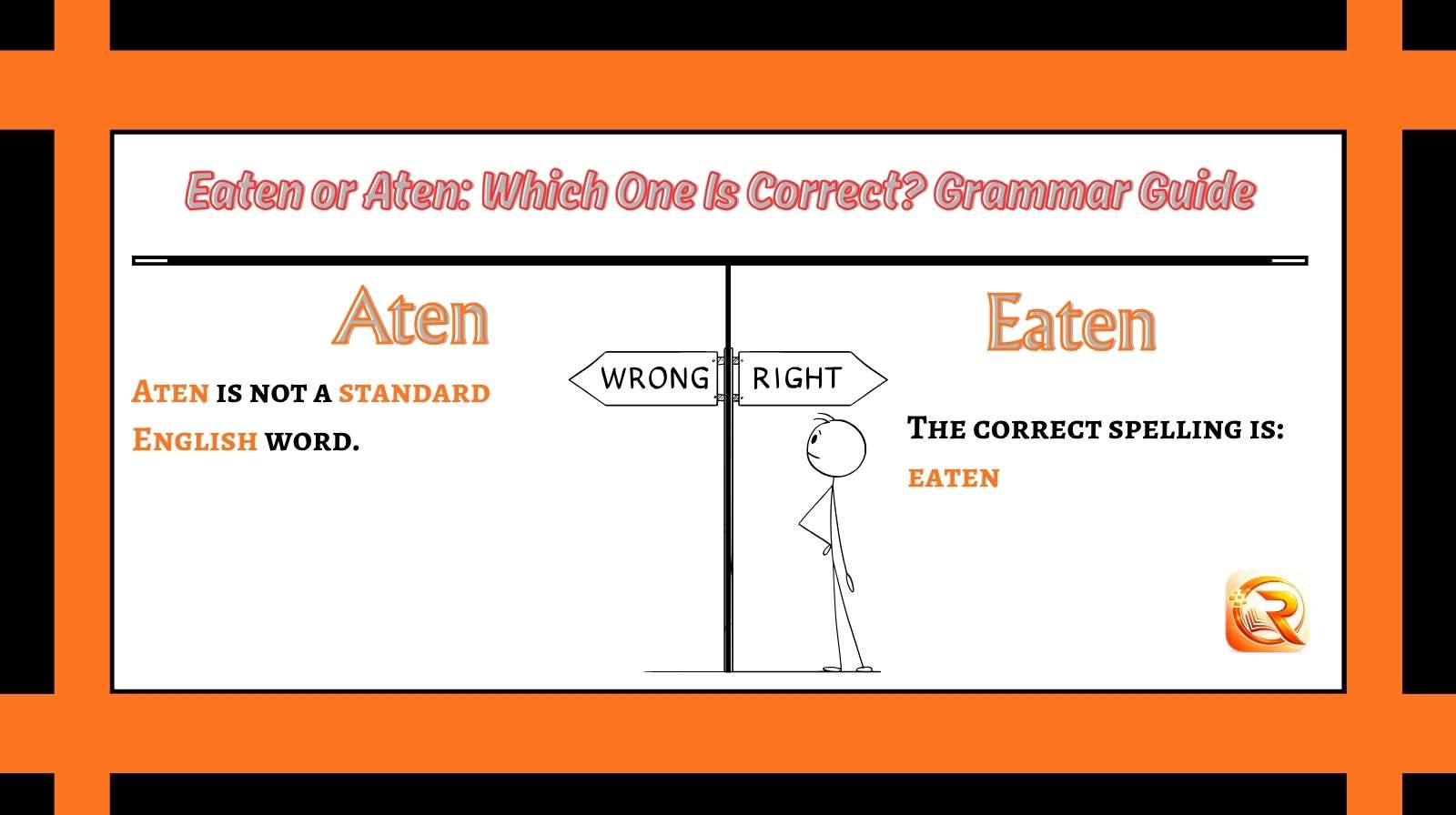
The short answer is simple:
- Eaten ✅ is the correct English word.
- Aten ❌ is not a standard English word.
Many learners mistakenly create aten because they notice the pattern between eat and ate. However, English contains many irregular verbs, meaning their forms don’t follow predictable spelling rules.
The Correct Verb Forms of Eat
| Verb Form | Correct Word | Example |
|---|---|---|
| Base Form | eat | I eat breakfast every day. |
| Past Tense | ate | I ate breakfast this morning. |
| Past Participle | eaten | I have eaten breakfast already. |
| Present Participle | eating | She is eating lunch now. |
The third form, eaten, is always used with helping verbs such as:
- has
- have
- had
- be
- been
Examples
✅ I have eaten dinner already.
✅ She has eaten all the cookies.
✅ They had eaten before arriving.
❌ I have aten dinner.
❌ She has aten breakfast.
In every formal grammar guide and dictionary, eaten is the only accepted spelling.
Why Do People Write “Aten”?
Many English learners naturally assume that adding -n to ate creates the past participle. Since English spelling is often inconsistent, this mistake feels logical.
Several reasons explain why this error happens.
Confusion Between Sound and Spelling
The pronunciation of eaten can sound similar to “eaten” with a soft middle sound, especially in fast conversation. Some learners interpret that pronunciation as aten when writing.
For example:
Spoken:
I’ve eaten already.
Fast pronunciation may make the middle vowel less noticeable, leading beginners to spell it incorrectly.
Influence of Regular Verb Patterns
Most English verbs follow predictable rules.
Examples include:
- walk → walked
- jump → jumped
- play → played
Learners often expect similar patterns from every verb. Unfortunately, eat is irregular.
Its forms must simply be memorized:
- eat
- ate
- eaten
Typing Errors and Autocorrect
Sometimes aten appears because of quick typing or autocorrect mistakes. Fortunately, most grammar checkers immediately flag aten as an incorrect spelling.
If your spell checker underlines aten, it is almost certainly suggesting eaten.
Understanding the Verb Forms of “Eat”
Learning irregular verbs becomes much easier once you understand how English tenses work.
Base Form: Eat
The base form is used for:
- Present simple
- Infinitives
- Commands
Examples:
- I eat fruit every day.
- We eat together.
- Eat your vegetables.
Past Tense: Ate
Use ate when describing a completed action in the past.
Examples:
- I ate lunch at noon.
- They ate pizza yesterday.
- She ate before leaving.
Notice that ate never appears with have, has, or had.
Incorrect:
❌ I have ate dinner.
Correct:
✅ I have eaten dinner.
Past Participle: Eaten
The past participle always appears with helping verbs.
Examples:
- I have eaten.
- She has eaten.
- We had eaten.
- They have eaten enough.
This rule never changes.
Present Participle: Eating
Use eating for continuous tenses.
Examples:
- I am eating.
- They were eating.
- She is eating now.
Understanding these four forms helps eliminate dozens of grammar mistakes beyond just eaten versus aten.
Why “Eaten” Is Grammatically Correct
The word eaten is the officially recognized past participle of the verb eat. English relies on past participles to form perfect tenses and passive constructions.
For example:
Present Perfect:
I have eaten breakfast.
Past Perfect:
They had eaten before the meeting.
Future Perfect:
She will have eaten by noon.
Passive Voice:
The cake was eaten by the children.
Replacing eaten with aten makes each sentence grammatically incorrect because aten does not exist in standard English.
Common Sentences Using “Eaten”
Here are examples that demonstrate proper usage in everyday English.
Daily Conversation
- I have eaten already.
- Have you eaten lunch?
- She hasn’t eaten anything today.
- We had eaten before the movie started.
Academic Writing
- Participants had eaten before the experiment began.
- Students who had eaten breakfast performed better during the morning session.
Professional Communication
- The guests have eaten and are ready for the presentation.
- Everyone had eaten before the conference began.
Notice how every sentence uses eaten after a helping verb.
A Quick Memory Trick
A simple trick can help you remember the correct form forever.
Think of the complete sequence:
Eat → Ate → Eaten
Whenever you use have, has, or had, your brain should immediately jump to the third form:
- have eaten
- has eaten
- had eaten
Never use:
- have ate
- has ate
- had ate
- have aten
- has aten
This one rule will prevent one of the most common irregular verb mistakes in English.
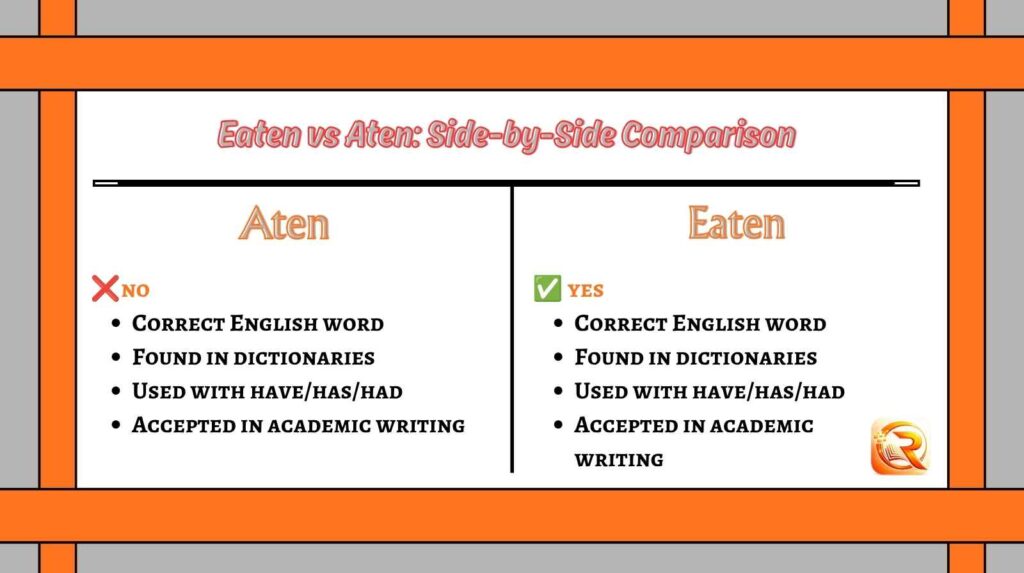
Eaten vs Aten: Side-by-Side Comparison
| Feature | Eaten | Aten |
|---|---|---|
| Correct English word | ✅ Yes | ❌ No |
| Part of speech | Past participle of eat | Not a standard English word |
| Found in dictionaries | ✅ Yes | ❌ No |
| Used with have/has/had | ✅ Yes | ❌ No |
| Accepted in academic writing | ✅ Yes | ❌ No |
| Accepted in business writing | ✅ Yes | ❌ No |
| Appropriate for exams | ✅ Yes | ❌ No |
Featured Snippet Answer
Is “aten” a real English word?
No. Aten is not a standard English word. The correct past participle of eat is eaten. Use eaten after helping verbs like have, has, and had, such as “I have eaten breakfast.”
Common Mistakes and How to Avoid Them
Even advanced English learners occasionally confuse irregular verbs. Fortunately, this mistake is easy to fix once you know what to watch for.
Mistake 1: Using “Aten” Instead of “Eaten”
❌ I have aten lunch.
✅ I have eaten lunch.
Remember that aten is never correct in standard English.
Mistake 2: Using “Ate” After Helping Verbs
Many people write:
❌ She has ate dinner.
The correct sentence is:
✅ She has eaten dinner.
Whenever you see have, has, or had, think of the third verb form.
Mistake 3: Mixing Up Past Tense and Past Participle
Compare these examples:
Past Tense
- I ate dinner yesterday.
Present Perfect
- I have eaten dinner already.
The first sentence describes a completed action in the past. The second connects that past action to the present.
How to Remember the Correct Form Forever
Irregular verbs often become easier when learned as complete sets rather than individual words.
Instead of memorizing only one form, practice the entire sequence:
Eat → Ate → Eaten
Repeat it several times until it becomes automatic.
Another helpful trick is to focus on helping verbs.
If your sentence contains:
- have
- has
- had
- will have
- could have
- should have
the next verb should usually be a past participle.
Examples:
- I have eaten.
- She has eaten.
- They had eaten.
- We should have eaten earlier.
This simple habit eliminates many common grammar mistakes.
Real-Life Example: How One Grammar Mistake Changed a Job Application
Imagine a university graduate applying for an international marketing position. The company asked candidates to submit a short paragraph describing a memorable travel experience.
One applicant wrote:
“I have aten many traditional foods during my trip to Italy.”
Although the rest of the application was well written, the recruiter immediately noticed the spelling mistake. Since the role required strong written English, the error created a poor first impression. It suggested that the applicant was unfamiliar with basic English verb forms or had not carefully proofread the document.
Another candidate described a similar experience but wrote:
“I have eaten many traditional foods during my trip to Italy, and each meal helped me understand the local culture.”
The second version sounded natural, grammatically correct, and professional. While a single spelling mistake may not always determine the outcome of an application, consistent grammar accuracy helps build credibility. Whether you’re writing emails, assignments, blog posts, or résumés, using the correct form eaten instead of aten shows attention to detail and strengthens your communication.
Why Grammar Accuracy Matters in Everyday Writing
Small grammar mistakes can have a surprisingly large impact. Using the correct verb forms improves both clarity and credibility.
Correct grammar is especially important for:
Academic Writing
Teachers and examiners expect proper verb forms in essays, assignments, and research papers.
Professional Emails
Employers often judge professionalism based on written communication.
Blogging and Content Writing
Accurate grammar helps build reader trust and improves the overall quality of your content.
Social Media and Online Communication
While casual conversations allow for informal language, correct grammar still makes your posts easier to understand and more professional.
English Learning Statistics (2025–2026)
Recent education reports highlight the growing importance of English proficiency worldwide.
- More than 1.5 billion people use English either as a first or additional language, making it one of the world’s most widely used languages.
- Millions of learners prepare each year for international English proficiency exams such as IELTS, TOEFL, and Cambridge English, where accurate grammar plays a significant role in writing and speaking scores.
- Digital language-learning platforms continue to grow rapidly through 2025–2026, reflecting sustained global demand for practical grammar instruction and writing skills.
- Educational research consistently shows that mastering common irregular verbs is one of the earliest milestones in improving English fluency and reducing writing errors.
These trends reinforce why understanding verb forms like eat → ate → eaten remains an essential part of learning English effectively.
Quick Checklist Before You Write
Use this checklist whenever you’re unsure.
- ✅ Use eat as the base form.
- ✅ Use ate only for the simple past.
- ✅ Use eaten after have, has, or had.
- ✅ Remember that aten is never correct in standard English.
- ✅ Proofread your writing before submitting or publishing it.
Mini Quiz: Test Your Knowledge About Eaten or Aten
Think you’ve mastered the difference between Eaten or Aten? Try these fun fill-in-the-blank questions and check your answers below!
- I have ______ my breakfast before leaving home.
- She ______ dinner at 8 PM yesterday.
- The correct verb sequence is eat → ate → ______.
- Have you ______ anything today?
- They had already ______ lunch before the meeting started.
- I usually ______ fruits in the morning.
- He ______ a delicious meal at the restaurant last night.
- “Aten” is a ______ spelling mistake, not a correct English word.
- The past participle form of “eat” is ______.
- We have ______ enough food for everyone.
- She has ______ all the cookies from the jar.
- The sentence “I have ate lunch” should be corrected to “I have ______ lunch.”
- English verbs like “eat” that do not follow regular patterns are called ______ verbs.
- He was hungry because he had not ______ anything all day.
- The correct word after “has” is ______, not “ate.”
- They ______ pizza yesterday evening.
- A sentence using the correct form is: “I have ______ breakfast already.”
- The three main forms of the verb eat are ______, ate, and eaten.
- Using “aten” in formal writing can create a grammar ______.
- To remember the correct forms, always practice: Eat → Ate → ______.
Quiz Answers
- eaten
- ate
- eaten
- eaten
- eaten
- eat
- ate
- incorrect
- eaten
- eaten
- eaten
- eaten
- irregular
- eaten
- eaten
- ate
- eaten
- eat
- mistake
- eaten
References
- Merriam-Webster — Merriam-Webster Dictionary (definitions and verb usage).
- British Council — English grammar resources and guidance.
Frequently Asked Questions
Q: Is “aten” ever correct?
No. Aten is not recognized as a standard English word. The correct past participle of eat is eaten.
Q: Why do people write “aten”?
Most people create aten by applying regular spelling patterns to an irregular verb. Since eat changes to ate in the past tense, some assume the next form is aten, but English uses eaten instead.
Q: What are the three forms of the verb “eat”?
The verb forms are:
- Eat
- Ate
- Eaten
These forms should be memorized together because eat is an irregular verb.
Q: Can I write “I have ate”?
No.
The correct sentence is:
I have eaten.
The phrase have ate is grammatically incorrect.
Q: Is “eaten” the past tense?
No.
The past tense is ate.
Eaten is the past participle, which is used with helping verbs such as have, has, and had.
Q: How can I remember the correct form?
Practice the sequence:
Eat → Ate → Eaten
Whenever you see have, has, or had, use eaten.
Final Thoughts
If you’ve been wondering whether eaten or aten is the correct choice, the answer is straightforward: eaten is the only correct word in standard English. Aten is a common spelling mistake that does not appear in accepted English grammar.
Learning irregular verbs takes practice, but remembering the sequence eat → ate → eaten makes it much easier to choose the correct form every time. Whether you’re writing an academic paper, sending a professional email, creating website content, or simply improving your English, using the correct verb forms strengthens your writing and helps you communicate with confidence.
The next time you pause before writing “I have eaten” or “I have aten,” you’ll know exactly which one belongs in your sentence.
Keep learning with more easy grammar lessons on Rule Scoope

I’m Bilal SEO Expert, the creator of RuleScoope, where I publish grammar guides and explain confusing words to help readers communicate clearly and confidently in English.