Have you ever paused while writing and wondered whether the correct word is leafs or leaves? You’re not alone. This is one of the most common grammar questions English learners, students, and even native speakers ask.
At first glance, adding -s to leaf seems logical because many English nouns become plural that way. However, English contains many irregular plural nouns, and leaf is one of them.
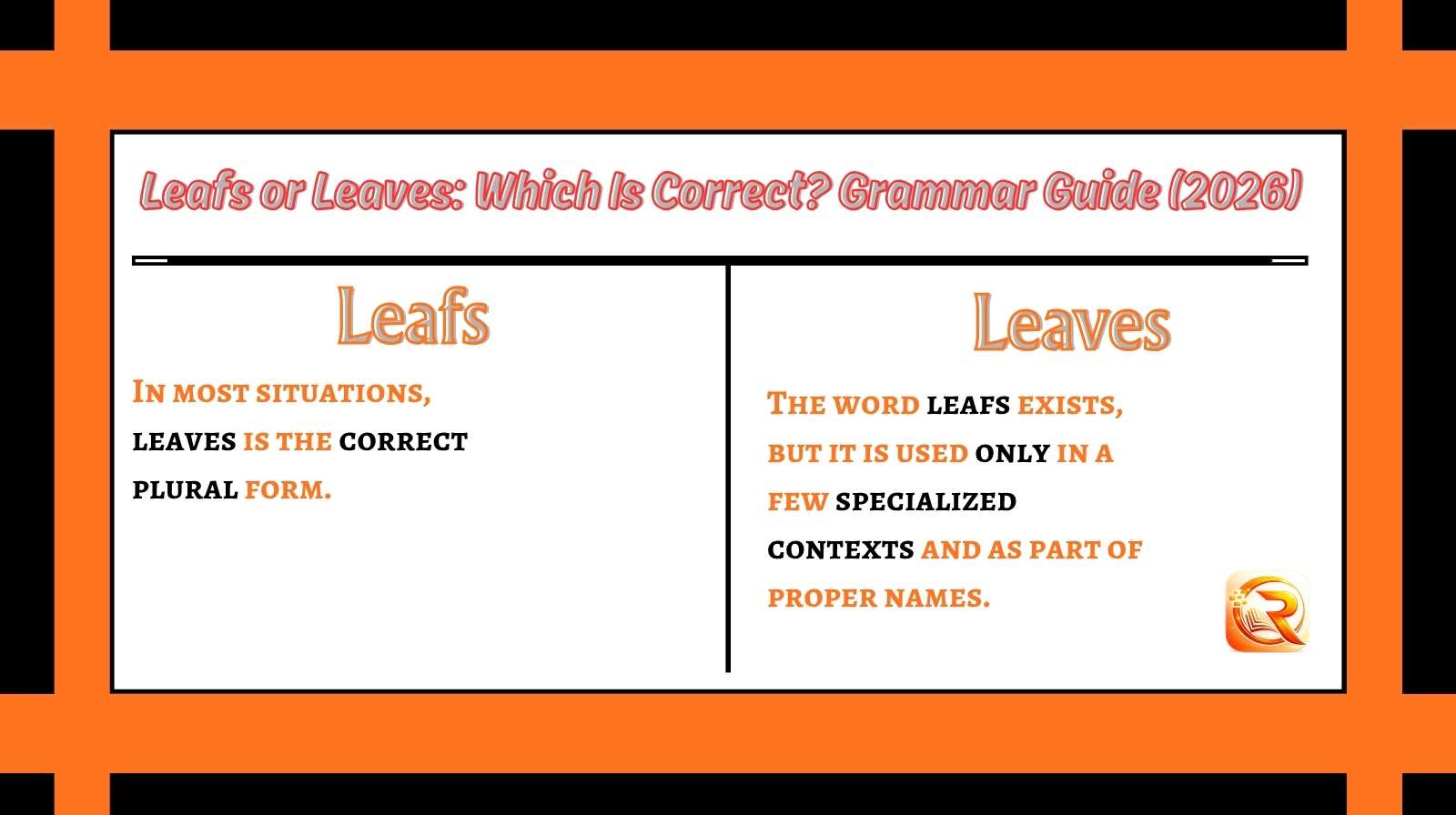
In most situations, leaves is the correct plural form. The word leafs exists, but it is used only in a few specialized contexts and as part of proper names.
By the end of this guide, you’ll understand:
- Why leaves is usually correct
- When leafs can be used
- The grammar rule behind the plural
- Easy tricks to remember the difference
- Common mistakes to avoid
- Plenty of real-world examples
Let’s begin with the most important question.
What Is the Correct Plural: Leafs or Leaves?
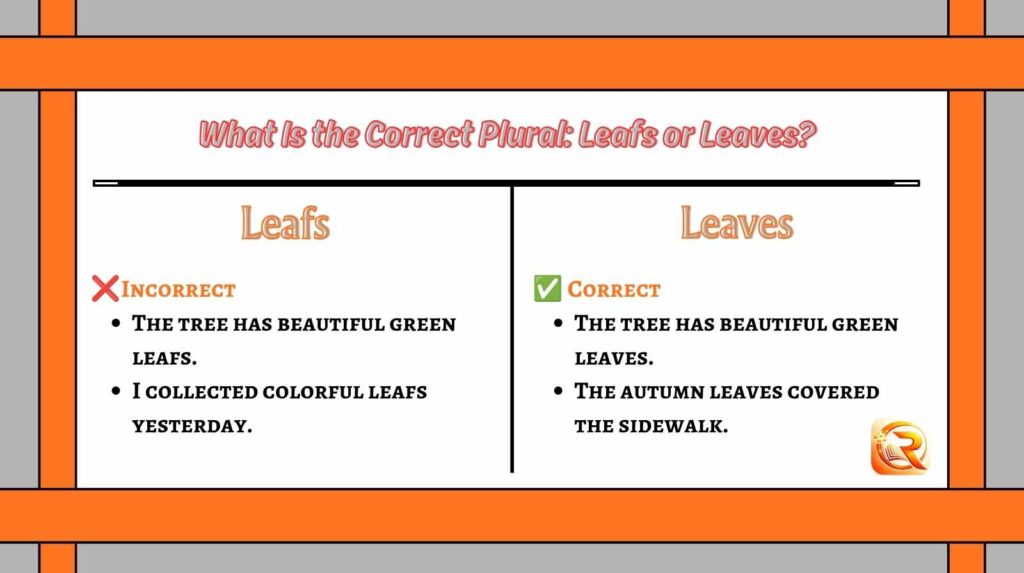
The correct plural of leaf is leaves.
✅ Correct
- The tree has beautiful green leaves.
- The autumn leaves covered the sidewalk.
- Birds build nests using dry leaves.
❌ Incorrect
- The tree has beautiful green leafs.
- I collected colorful leafs yesterday.
In standard English, dictionaries recognize leaves as the accepted plural form of leaf.
Featured Snippet Answer
The correct plural of “leaf” is “leaves.” The form “leafs” is rarely used except in specific technical contexts and proper names such as the Toronto Maple Leafs.
Why Does Leaf Become Leaves?
English contains a group of nouns ending in -f or -fe that change to -ves in the plural.
Examples include:
| Singular | Plural |
|---|---|
| Leaf | Leaves |
| Wolf | Wolves |
| Knife | Knives |
| Life | Lives |
| Shelf | Shelves |
| Wife | Wives |
| Calf | Calves |
| Half | Halves |
This spelling change developed through the historical evolution of English pronunciation and has remained part of modern grammar.
Not every -f noun follows this rule.
For example:
- Roof → Roofs
- Chief → Chiefs
- Belief → Beliefs
- Cliff → Cliffs
- Proof → Proofs
Because English has both regular and irregular plural forms, memorizing common exceptions is helpful.
Understanding the Grammar Rule
Many singular nouns ending in -f or -fe replace those endings with -ves when pluralized.
Formula
Singular ending in -f
↓
Remove f
↓
Add ves
Example:
Leaf
↓
Leaves
This transformation is considered an irregular plural because it doesn’t simply add -s.
Why Doesn’t Every Word Follow This Rule?
English developed from several languages, including Old English, French, Latin, and Germanic languages.
As vocabulary expanded over centuries, some nouns kept the -ves pattern while others adopted the simpler -s ending.
That’s why English learners often encounter exceptions.
Quick Memory Tip
Think about autumn.
One leaf falls.
Many leaves fall.
Visualizing a tree dropping hundreds of leaves helps reinforce the correct plural naturally.
When Is “Leafs” Actually Correct?
Although leafs is incorrect as the ordinary plural of leaf, it is not always wrong.
There are several situations where leafs is acceptable.
1. Proper Names
The most famous example is the Toronto Maple Leafs, the professional hockey team.
The team intentionally uses Leafs instead of Leaves for branding and historical reasons.
Example:
- The Toronto Maple Leafs won the game.
This is a proper noun and should never be corrected to “Leaves.”
2. Printing and Bookbinding
In publishing and printing, a leaf refers to one sheet of paper containing two pages.
Professionals sometimes use leafs when discussing printed sheets in technical documentation.
Example:
- The printer inserted several extra leafs into the manual.
Although some style guides still recommend leaves, technical industries occasionally use leafs.
3. Specialized Mechanical Uses
Certain engineering or manufacturing industries may use leafs when discussing components such as leaf springs or machine parts.
These usages are uncommon outside technical writing.
Also Read: Gnaw or Knaw? Correct Spelling Explained (2026 Guide)
Leaves in Everyday English
Nearly every everyday conversation uses leaves.
Examples include nature, gardening, biology, education, and literature.
Nature
- The wind blew the leaves across the yard.
- Green leaves produce food through photosynthesis.
Gardening
- Remove dead leaves from the plants.
- Wet leaves can encourage mold growth.
School
- Students collected leaves for their science project.
Literature
- The poet compared falling leaves to passing time.
If you’re writing for general readers, leaves is almost always the correct choice.
Common Sentences Using Leaves
Here are examples that sound natural in everyday English.
- The leaves turned golden in October.
- Fresh leaves appeared after spring rain.
- The gardener raked the leaves every weekend.
- The leaves rustled gently in the breeze.
- Children jumped into piles of colorful leaves.
- Wet leaves made the road slippery.
- Dry leaves burned quickly.
- Birds hid among the leaves.
- The leaves provided welcome shade.
- We collected maple leaves during our hike.
These examples reflect how native speakers naturally use the word.
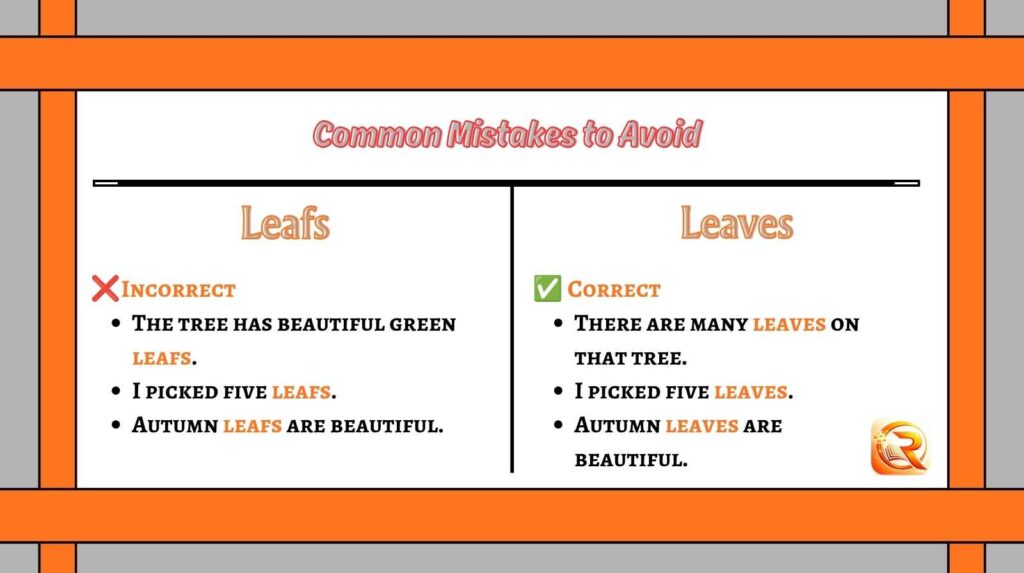
Common Mistakes to Avoid
Many writers make similar errors.
Mistake 1
❌ There are many leafs on that tree.
✅ There are many leaves on that tree.
Mistake 2
❌ I picked five leafs.
✅ I picked five leaves.
Mistake 3
❌ Autumn leafs are beautiful.
✅ Autumn leaves are beautiful.
Mistake 4
❌ The garden is full of leafs.
✅ The garden is full of leaves.
Mistake 5
❌ Every tree dropped its leafs.
✅ Every tree dropped its leaves.
Avoiding these mistakes will make your writing sound much more natural.
Comparison Table: Leafs vs. Leaves
| Feature | Leafs | Leaves |
|---|---|---|
| Standard English plural | ❌ No | ✅ Yes |
| Everyday writing | ❌ Rare | ✅ Correct |
| Academic writing | ❌ Avoid | ✅ Recommended |
| Business writing | ❌ Avoid | ✅ Correct |
| School assignments | ❌ Incorrect | ✅ Correct |
| Nature discussions | ❌ Incorrect | ✅ Correct |
| Dictionary standard | Rare usage | Standard plural |
| Proper names | ✅ Sometimes | ❌ Not used |
| Technical industries | Occasionally | Often preferred |
| Best choice for most writers | No | Yes |
Also Read: Amount or Ammount: Which Spelling Is Correct? (2026 Guide)
Leaves in Different Contexts
Science
Scientists refer to plant leaves because they perform photosynthesis and exchange gases.
Gardening
Gardeners trim unhealthy leaves to encourage healthy growth.
Biology
Biologists study how different leaves adapt to various climates.
Writing
Authors often use leaves as symbols of seasons, life, and change.
Real-Life Example: How One Small Grammar Mistake Changed an Article’s Credibility
Imagine two bloggers writing an article about autumn.
Writer A publishes the sentence:
“The colorful leafs covered the streets after the storm.”
Most readers understand the intended meaning, but those familiar with English grammar immediately notice the incorrect plural. Teachers, editors, and native speakers may question the writer’s attention to detail. If the article contains several similar mistakes, readers may become less confident in the overall quality of the content.
Writer B, however, writes:
“The colorful leaves covered the streets after the storm.”
The sentence reads naturally and follows standard English grammar. It sounds polished, professional, and trustworthy.
Now imagine these two articles competing for readers. The second article is more likely to earn positive feedback, be shared by educators, and be viewed as a reliable grammar resource. Small language choices like using leaves instead of leafs contribute to a better reading experience and stronger credibility.
The lesson is simple: grammar accuracy matters. While one incorrect word may seem minor, consistent correctness helps build trust with your audience. Whenever you’re referring to the plural of leaf in everyday English, choosing leaves is the safest and most professional option.
What Do Dictionaries Say?
Leading English dictionaries agree that leaves is the standard plural of leaf.
Here’s how major dictionary publishers define it:
| Dictionary | Standard Plural |
|---|---|
| Merriam-Webster | Leaves |
| Cambridge Dictionary | Leaves |
| Oxford English Dictionary | Leaves |
| Collins Dictionary | Leaves |
These trusted references also note that leafs appears only in limited technical uses or as part of certain proper names.
Also Read: Quizes or Quizzes: Which Spelling Is Correct?
Grammar Rule: Other Words That Follow the Same Pattern
Learning similar words makes the rule easier to remember.
| Singular | Plural |
|---|---|
| Leaf | Leaves |
| Knife | Knives |
| Wife | Wives |
| Wolf | Wolves |
| Shelf | Shelves |
| Half | Halves |
| Calf | Calves |
| Loaf | Loaves |
| Elf | Elves |
| Life | Lives |
Notice the consistent -f → -ves pattern.
Exceptions to the Rule
Not every noun ending in -f changes to -ves.
These common words simply add -s.
| Singular | Plural |
|---|---|
| Roof | Roofs |
| Chief | Chiefs |
| Belief | Beliefs |
| Cliff | Cliffs |
| Proof | Proofs |
| Safe | Safes |
| Gulf | Gulfs |
| Handkerchief | Handkerchiefs (or Handkerchieves in rare usage) |
Because English evolved over centuries, there is no single rule that applies to every -f noun. When in doubt, consult a reliable dictionary.
2025–2026 Data: Why Grammar Accuracy Still Matters
Although English grammar rules rarely change, the importance of writing correctly continues to grow as more content is published online.
Recent industry findings highlight this trend:
- Google’s Search Quality Evaluator Guidelines (updated through 2025) continue to emphasize creating helpful, accurate, and trustworthy content that demonstrates expertise and satisfies user intent.
- Studies from professional writing platforms consistently show that readers are more likely to trust content with correct grammar and spelling than content containing frequent language errors.
- Educational publishers and language-learning platforms in 2025–2026 continue teaching leaves as the accepted plural of leaf, reinforcing its use in schools, exams, and professional writing.
While a single typo may not determine search rankings, consistently accurate grammar improves readability, user trust, and the overall quality of your content.
Quick Checklist: Are You Using the Right Word?
Before publishing your writing, ask yourself:
- ✅ Am I talking about more than one leaf?
- ✅ Is this everyday English?
- ✅ Is this school, business, or professional writing?
- ✅ Am I referring to tree leaves or plant leaves?
If you answered yes, then the correct word is leaves.
Use leafs only when:
- You’re referring to the Toronto Maple Leafs.
- You’re writing about a specialized technical context where leafs is the accepted term.
Also Read: Chello or Cello: Which Spelling Is Correct? (Grammar Guide 2026)
Mini Quiz: Test Your Knowledge About Leafs or Leaves
Think you’ve mastered the difference between Leafs or Leaves? Try these fun fill-in-the-blank questions and check your answers below!
1. The tree lost all its ______ during autumn.
2. The correct plural of leaf is ______.
3. Birds often build nests using dry ______.
4. The wind blew colorful ______ across the yard.
5. In standard English, leafs is generally considered ______ for the plural of leaf.
6. One leaf, many ______.
7. The gardener raked the fallen ______ into a pile.
8. The word leaf follows the -f to -______ plural rule.
9. The Toronto Maple ______ is a famous hockey team.
10. Green ______ help plants produce food through photosynthesis.
11. Most dictionaries list ______ as the standard plural of leaf.
12. The children collected colorful ______ for their school project.
13. Leafs is mainly used in certain ______ contexts and proper names.
14. The trees grew fresh ______ during spring.
15. The sentence “The garden is full of leafs” is grammatically ______.
16. The sentence “The garden is full of leaves” is grammatically ______.
17. Words like knife → knives and leaf → ______ follow the same spelling pattern.
18. In everyday English, writers should almost always use ______ instead of leafs.
19. Fallen ______ often cover the ground in autumn.
20. Using the correct plural helps make your writing more ______.
Quiz Answers
- leaves
- leaves
- leaves
- leaves
- incorrect
- leaves
- leaves
- ves
- Leafs
- leaves
- leaves
- leaves
- technical
- leaves
- incorrect
- correct
- leaves
- leaves
- leaves
- professional
References
- Merriam-Webster Dictionary. Leaf (Plural: Leaves)
- Cambridge Dictionary. Leaf English Grammar and Usage
Frequently Asked Questions
Q: Is “leafs” ever grammatically correct?
Yes, but only in limited situations such as certain technical fields or proper names like the Toronto Maple Leafs. In standard English, leaves is the correct plural of leaf.
Q: Why isn’t the plural simply “leafs”?
English has many irregular plural nouns. Words like leaf, knife, and wolf change -f to -ves instead of simply adding -s.
Q: Is “leaves” always the correct plural?
For everyday English, yes. Whether you’re talking about trees, plants, or nature, leaves is the accepted plural.
Q: Is “leafs” wrong in school writing?
Yes. Teachers, exams, and academic writing expect leaves unless you’re discussing a proper name or a specific technical usage.
Q: How can I remember the correct plural?
Think of autumn:
One leaf falls.
Many leaves fall.
This simple image helps reinforce the correct form.
Q: Which spelling should writers and bloggers use?
Always use leaves in articles, blog posts, essays, and professional documents unless you’re referring to a proper noun like the Toronto Maple Leafs.
Key Takeaways
- Leaves is the standard plural of leaf.
- Leafs is only correct in limited technical contexts and proper names.
- Leaf follows the irregular -f → -ves plural pattern.
- Most dictionaries and grammar guides recognize leaves as the accepted form.
- Using the correct plural improves clarity, professionalism, and reader trust.
Conclusion
Understanding the difference between leafs and leaves is easier once you know the grammar rule. In almost every everyday situation, leaves is the correct plural of leaf, while leafs is reserved for a handful of specialized uses and proper names. By applying this rule consistently, you’ll write with greater confidence and accuracy.
If you found this guide helpful, explore more grammar and confusing-word articles to strengthen your English writing skills and avoid common mistakes in everyday communication.
Keep learning with more easy grammar lessons on Rule Scoope

I’m Bilal SEO Expert, the creator of RuleScoope, where I publish grammar guides and explain confusing words to help readers communicate clearly and confidently in English.