Have you ever typed “knaw” and wondered whether it was actually a real word? You’re not alone. Thousands of English learners, students, bloggers, and even native speakers search every year to verify the correct spelling of commonly confused words.
One such confusion is “gnaw” vs. “knaw.” At first glance, both words seem plausible because English contains many silent letters. However, only one spelling is recognized in modern English dictionaries.
In this guide, you’ll learn the correct spelling, pronunciation, meaning, grammar rules, real-world examples, common mistakes, and easy memory tricks to ensure you never confuse these words again. By the end, you’ll confidently know when and how to use gnaw correctly in both writing and conversation.
What Is the Correct Spelling: Gnaw or Knaw?
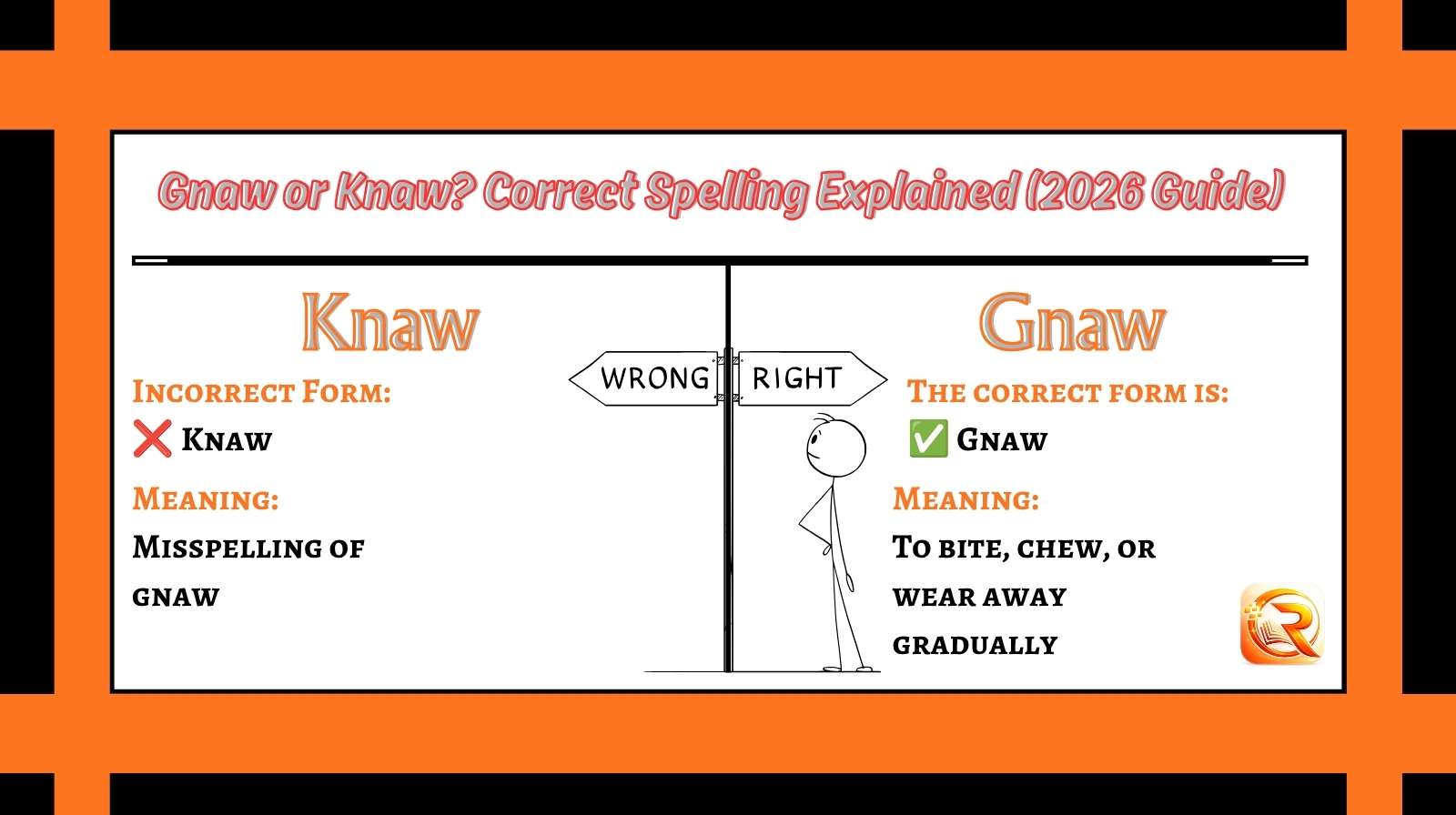
The correct spelling is gnaw.
Knaw is not a standard English word and is considered a misspelling.
Quick Answer
| Word | Correct? | Meaning |
|---|---|---|
| Gnaw | ✅ Yes | To bite, chew, or wear away gradually |
| Knaw | ❌ No | Misspelling of gnaw |
Dictionary Definition of Gnaw
According to major dictionaries, gnaw means:
To bite or chew something repeatedly.
It can also mean:
To cause persistent worry, anxiety, or discomfort.
Examples
- The dog continued to gnaw on the bone.
- Rats can gnaw through wood and plastic.
- Fear began to gnaw at his confidence.
In every case, gnaw is the only correct spelling.
Why Do People Confuse Gnaw and Knaw?
Many English spelling mistakes occur because pronunciation doesn’t always match spelling.
Silent Letters Create Confusion
English contains many words with silent letters:
- Knife
- Knee
- Knock
- Knot
Since these words begin with “kn,” many people assume the verb should be spelled knaw.
However, gnaw belongs to a different group of words that begin with “gn.”
Similar Pronunciation
Both “gnaw” and the imagined spelling “knaw” would be pronounced similarly:
/nɔː/
Because the first letter is silent in both patterns, people often write the word based on sound rather than correct spelling.
Autocorrect and Typing Habits
Modern search data shows that spelling-related searches remain among the most common language queries online. Users frequently type words phonetically, especially on mobile devices, leading to misspellings like:
- knaw
- naw
- gnawedd
- gnauw
Search engines usually correct these automatically to gnaw.
What Does Gnaw Mean?
The word gnaw has both literal and figurative meanings.
Literal Meaning
The most common meaning involves chewing repeatedly.
Examples
- A puppy may gnaw on furniture while teething.
- Beavers gnaw through tree trunks.
- Rabbits often gnaw on wooden objects.
Figurative Meaning
Gnaw can also describe emotional discomfort that persists over time.
Examples
- Guilt continued to gnaw at her conscience.
- Doubt began to gnaw at his mind.
- Anxiety can gnaw at a person’s confidence.
Common Synonyms
Some semantic keywords related to gnaw include:
- chew
- nibble
- bite
- erode
- wear away
- worry
- trouble
- torment
These words are often used in similar contexts.
The History and Origin of the Word Gnaw
Understanding a word’s history often makes it easier to remember.
Old English Roots
The word gnaw comes from Old English “gnagan.”
For centuries, the spelling evolved while maintaining its original meaning of biting or chewing repeatedly.
Why Does Gnaw Start with “GN”?
In older forms of English and Germanic languages, the “g” was pronounced.
Over time, pronunciation changed, but spelling remained largely unchanged.
This is why modern English still uses:
- gnaw
- gnash
- gnat
- gnarl
Even though the initial “g” is silent.
Language Evolution
English preserves many historical spellings because dictionaries and educational systems standardize accepted forms.
As a result, gnaw survived while knaw never became an accepted variant.
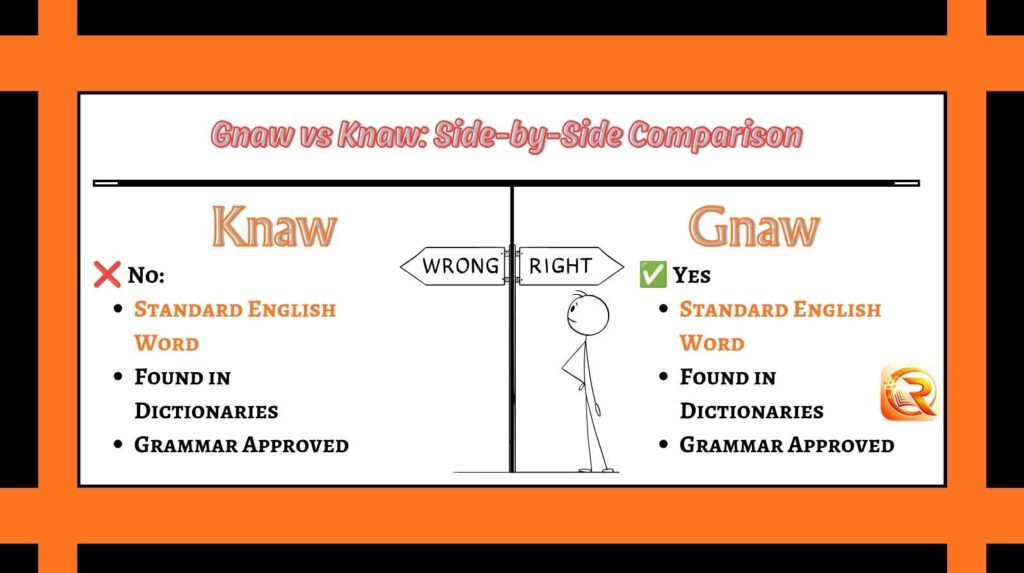
Gnaw vs Knaw: Side-by-Side Comparison
Many readers want a quick comparison before diving deeper.
Comparison Table
| Feature | Gnaw | Knaw |
|---|---|---|
| Standard English Word | Yes | No |
| Found in Dictionaries | Yes | No |
| Correct Spelling | Yes | No |
| Accepted in Academic Writing | Yes | No |
| Used by Native Speakers | Yes | No |
| Searchable Definition | Yes | No |
| Grammar Approved | Yes | No |
Key Takeaway
Whenever you’re unsure, choose gnaw.
There are no legitimate situations where knaw is preferred in standard English.
How to Remember the Correct Spelling of Gnaw
Memory tricks can help eliminate spelling mistakes permanently.
Trick 1: Think of Gnat
Both words begin with silent “gn.”
- Gnat
- Gnaw
If you remember one, you can remember the other.
Trick 2: Use the Bone Association
Imagine a dog chewing a bone.
Dogs gnaw bones.
Visual memory makes spelling easier to retain.
Trick 3: Remember the Dictionary Rule
When in doubt:
If you mean “chew repeatedly,” spell it gnaw.
Never spell it as knaw.
Quick Checklist
Before publishing or submitting writing:
✅ Does the word mean chew or bite repeatedly?
✅ Are you referring to persistent worry?
✅ Have you used the spelling “gnaw”?
✅ Have you avoided “knaw”?
If yes, you’re correct.
Real-Life Example: How a Small Spelling Error Hurt Search Visibility
A content writer managing an educational blog published an article about animal behavior. The article repeatedly used the word “knaw” instead of “gnaw.”
Initially, the writer assumed the spelling was acceptable because spell-check software missed a few instances. However, readers quickly noticed the mistake and left comments pointing it out.
The issue became more significant when the blog’s content quality review was conducted. Editors discovered the repeated misspelling across several pages.
Because search engines increasingly evaluate content quality, accuracy, and user trust signals, spelling errors can negatively affect perceived credibility. Visitors may leave a page faster when they encounter obvious mistakes, especially in educational content.
The team corrected every instance of “knaw” and replaced it with “gnaw.” They also updated related content and implemented a proofreading checklist.
Within a few months, user engagement improved. Readers spent more time on the site, and the content appeared more professional.
This example highlights an important lesson: even a single spelling error can affect reader trust. Whether you’re a student, blogger, marketer, or business owner, using the correct spelling demonstrates professionalism and attention to detail.
Language and Search Trends: 2025–2026 Data
Recent digital publishing and search industry reports indicate that language-related searches remain a major category of informational queries.
Several factors contribute to this trend:
- Increased content creation worldwide
- Growth of AI-assisted writing tools
- More non-native English speakers publishing online
- Higher emphasis on content quality and E-E-A-T standards
Key Insights
According to recent industry analyses:
- Millions of spelling-related searches occur every month.
- Grammar and spelling verification tools continue to experience growth in user adoption.
- Educational and language-learning content remains one of the strongest-performing informational content categories in search results.
What This Means for Writers
Correct spelling helps:
- Improve credibility
- Increase readability
- Build audience trust
- Reduce confusion
- Support professional communication
Even seemingly small distinctions like gnaw vs. knaw matter when creating authoritative content.
Common Mistakes Related to Gnaw
People often confuse gnaw with other words that sound similar.
Mistake 1: Writing Knaw
Incorrect:
❌ The dog likes to knaw bones.
Correct:
✅ The dog likes to gnaw bones.
Mistake 2: Confusing Gnaw with Naw
“Naw” is an informal word meaning “no” in some dialects.
Example:
- Naw, I don’t think so.
It does not mean chew.
Mistake 3: Using Gnaw Incorrectly
Incorrect:
❌ I gnaw the answer.
Correct:
✅ I know the answer.
Similar-Looking Words
| Word | Meaning |
|---|---|
| Gnaw | Chew repeatedly |
| Know | Be aware of |
| Gnat | Small flying insect |
| Gnash | Grind teeth |
| Naw | Informal no |
How to Use Gnaw Correctly in Sentences
As a Verb
The most common use.
Examples:
- The puppy likes to gnaw toys.
- Rodents can gnaw through cables.
- Beavers gnaw bark from trees.
In Emotional Contexts
Examples:
- Regret continued to gnaw at him.
- Uncertainty began to gnaw at investors.
- The memory still gnawed at her years later.
Different Verb Forms
| Form | Example |
|---|---|
| Gnaw | Dogs gnaw bones. |
| Gnaws | The puppy gnaws furniture. |
| Gnawed | The rat gnawed through plastic. |
| Gnawing | The dog is gnawing a toy. |
Mini Quiz: Test Your Knowledge of Gnaw or Knaw
Fill in the blanks below and check your answers at the end!
Fill in the Blank
- The correct spelling is ______, not knaw.
- Dogs often ______ on bones to keep their teeth busy.
- The word “knaw” is considered a ______.
- Rats can ______ through wood and plastic.
- The word “gnaw” comes from Old ______.
- In the word “gnaw,” the letter ______ is silent.
- Fear began to ______ at his confidence.
- “Gnaw” can describe both physical chewing and emotional ______.
- Beavers are known to ______ through tree trunks.
- The past tense of “gnaw” is ______.
- The puppy was ______ on a toy all afternoon.
- Words like gnat, gnash, and ______ share a silent “g.”
- “Gnaw” is used as a ______ in English grammar.
- Persistent guilt can ______ at a person’s conscience.
- The pronunciation of “gnaw” sounds similar to ______.
- Writers should avoid using the incorrect spelling ______.
- One synonym of “gnaw” is ______.
- English learners often confuse “gnaw” because of ______ letters.
- Search engines usually correct “knaw” to ______.
- Accurate spelling helps build reader ______.
Answer Key
- Gnaw
- Gnaw
- Misspelling
- Gnaw
- English
- G
- Gnaw
- Discomfort
- Gnaw
- Gnawed
- Gnawing
- Gnaw
- Verb
- Gnaw
- Naw
- Knaw
- Chew
- Silent
- Gnaw
- Trust
Frequently Asked Questions
Q: Is knaw a real word?
No. Knaw is not recognized as a standard English word and is considered a misspelling of gnaw.
Q: What does gnaw mean?
Gnaw means to bite or chew repeatedly. It can also refer to persistent emotional discomfort or worry.
Q: Why is the G silent in gnaw?
The word comes from older Germanic language roots where the “g” was pronounced. Modern pronunciation changed while spelling remained.
Q: How do you pronounce gnaw?
Gnaw is pronounced:
/nɔː/
It sounds similar to “naw.”
Q: What is the past tense of gnaw?
The past tense is:
gnawed
Example:
- The dog gnawed the bone yesterday.
Q: Can gnaw be used figuratively?
Yes.
Example:
- Fear gnawed at his confidence.
Q: What words are similar to gnaw?
Related words include:
- chew
- nibble
- bite
- gnash
- erode
- wear away
External References
For additional language authority and grammar guidance, consult:
Conclusion
When comparing gnaw or knaw, the answer is straightforward: gnaw is the correct spelling, while knaw is a misspelling.
The word gnaw means to chew repeatedly or to cause ongoing emotional distress. Although English contains many words beginning with “kn,” this particular word follows the silent “gn” pattern found in words like gnat and gnash.
Whenever you’re writing, editing, studying, or publishing content, remember this simple rule:
If you mean “to chew, bite repeatedly, or worry persistently,” always use gnaw.
Bookmark this guide for future reference, and share it with anyone who has ever wondered whether gnaw or knaw is the correct spelling. Accurate language builds credibility and every correctly spelled word strengthens your writing.
Keep learning with more easy grammar lessons on Rule Scoope

I’m Bilal SEO Expert, the creator of RuleScoope, where I publish grammar guides and explain confusing words to help readers communicate clearly and confidently in English.