Have you ever typed “repore” while writing an email, blog post, resume, or business document and wondered if it was actually correct?
You’re not alone.
Thousands of people search every year for terms like “repore meaning,” “repore vs rapport,” and “is repore a word?” because the two spellings sound very similar when spoken aloud. However, only one of them is recognized as the correct English word.
In this guide, you’ll learn the difference between repore and rapport, discover the correct spelling, understand its meaning, see real-world examples, and learn how to use it properly in professional and everyday communication.
By the end of this article, you’ll never confuse these terms again.
What Is the Correct Spelling: Repore or Rapport?
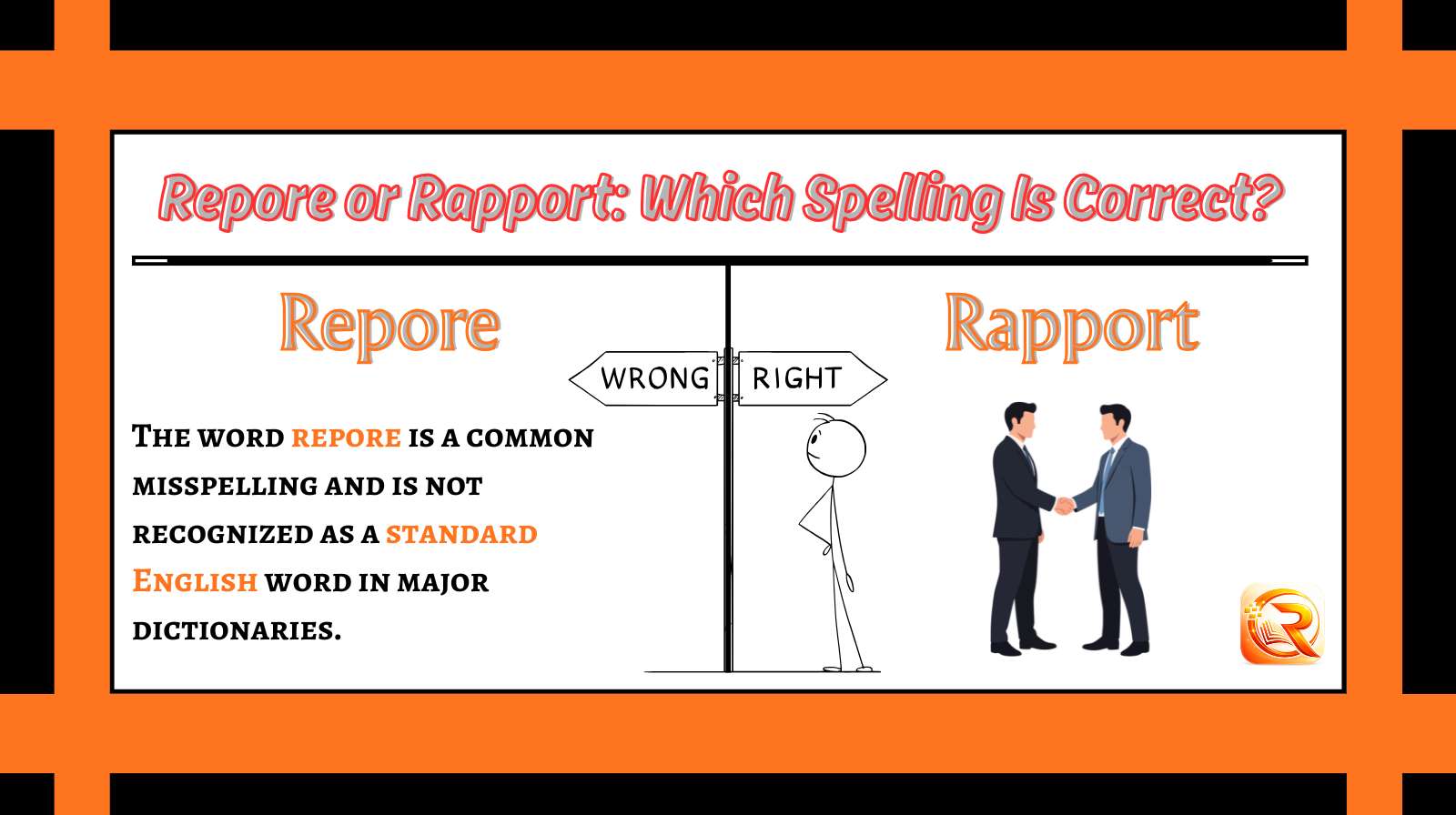
The correct spelling is rapport.
The word repore is a common misspelling and is not recognized as a standard English word in major dictionaries.
Quick Answer
| Term | Correct? | Meaning |
|---|---|---|
| Rapport | ✅ Yes | A close and harmonious relationship |
| Repore | ❌ No | Misspelling of rapport |
Definition of Rapport
Rapport refers to a relationship characterized by mutual understanding, trust, and effective communication between people.
According to linguistic and dictionary sources, rapport describes a connection where individuals communicate comfortably and understand each other well.
Example Sentences
- The therapist quickly established a strong rapport with her patient.
- Building rapport with customers improves sales performance.
- Teachers often create rapport with students to encourage learning.
In all these examples, using “repore” would be incorrect.
Understanding the Meaning of Rapport
To use the word correctly, it’s important to understand what rapport actually means.
Rapport in Professional Communication
In workplaces, rapport refers to positive relationships between colleagues, managers, clients, and business partners.
For example:
A sales representative who builds rapport with prospects often closes more deals because customers trust them.
Rapport in Personal Relationships
Rapport is not limited to business settings.
Friends, family members, and romantic partners often develop rapport through shared experiences, empathy, and communication.
Rapport in Psychology and Counseling
Psychologists frequently use the term rapport when describing trust between a therapist and client.
Research consistently shows that strong therapeutic rapport contributes to better treatment outcomes.
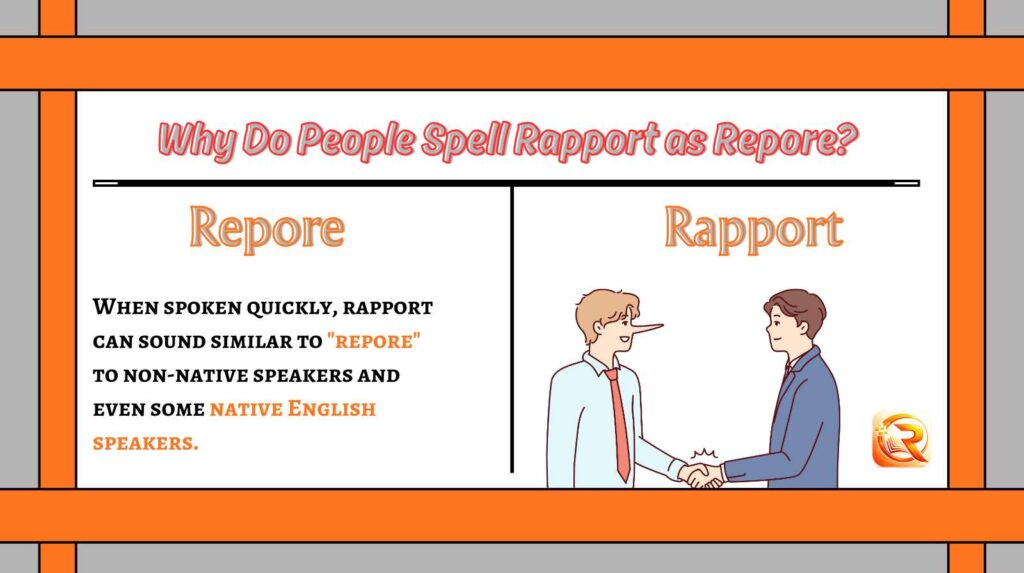
Why Do People Spell Rapport as Repore?
The confusion happens because of pronunciation.
When spoken quickly, rapport can sound similar to “repore” to non-native speakers and even some native English speakers.
Reason 1: French Origins
The word rapport originates from French.
Its pronunciation differs from how it appears in writing, making spelling mistakes more common.
Reason 2: Phonetic Assumptions
Many people attempt to spell words based on sound alone.
Because rapport is pronounced roughly as:
ruh-PORE
people naturally assume the spelling might be “repore.”
Reason 3: Informal Online Usage
Misspellings spread quickly online through forums, social media posts, comments, and user-generated content.
As a result, many people encounter “repore” before seeing the correct spelling.
Common Misspellings of Rapport
- Repore
- Rapore
- Rappore
- Rapor
- Raporrt
Among these, repore remains one of the most frequently searched variations.
The Origin and History of the Word Rapport
Understanding a word’s history often makes it easier to remember.
French Roots
The word rapport comes from the French term “rapporter,” meaning:
- To bring back
- To relate
- To establish a connection
The concept eventually evolved into describing harmony and mutual understanding between people.
Adoption into English
English speakers began using rapport in the 17th and 18th centuries.
Over time, it became widely used in:
- Business communication
- Psychology
- Education
- Sales
- Customer service
- Leadership training
Modern Usage in 2026
Today, rapport is considered a critical interpersonal skill across nearly every industry.
Whether you’re networking, interviewing, negotiating, teaching, or selling, building rapport remains essential.
How to Build Rapport Effectively
Understanding the word is useful, but knowing how to create rapport in real life is even more valuable.
Step 1: Practice Active Listening
People appreciate feeling heard.
Focus on understanding rather than preparing your next response.
Example:
Instead of interrupting, summarize what the other person has said before responding.
Step 2: Show Genuine Interest
Ask thoughtful questions and remain curious.
People naturally connect with those who value their opinions and experiences.
Step 3: Find Common Ground
Shared interests often accelerate rapport-building.
Examples:
- Similar career paths
- Shared hobbies
- Common goals
- Mutual acquaintances
Step 4: Use Positive Body Language
Nonverbal communication plays a significant role.
Maintain:
- Appropriate eye contact
- Open posture
- Friendly facial expressions
Step 5: Be Consistent and Authentic
Trust develops through repeated positive interactions.
Authenticity creates stronger and longer-lasting rapport than manipulation or scripted communication.
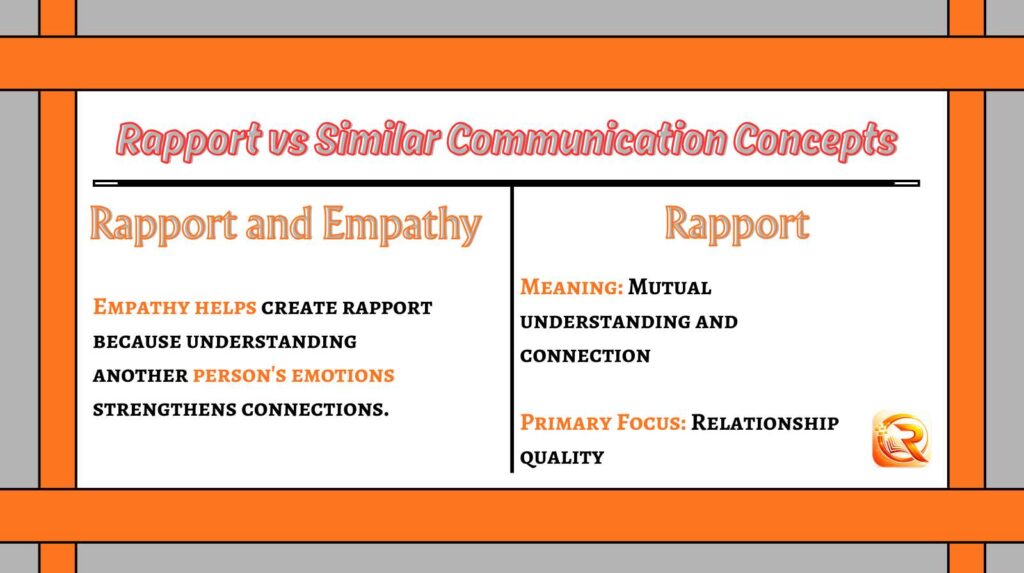
Rapport vs Similar Communication Concepts
Many people confuse rapport with other relationship-related terms.
Comparison Table
| Term | Meaning | Primary Focus |
|---|---|---|
| Rapport | Mutual understanding and connection | Relationship quality |
| Trust | Confidence in reliability and integrity | Dependability |
| Empathy | Understanding another person’s feelings | Emotional awareness |
| Communication | Exchange of information | Information sharing |
| Networking | Creating professional contacts | Opportunity building |
Rapport and Trust
Rapport often leads to trust, but they are not identical.
Someone may enjoy talking with you (rapport) before fully trusting you.
Rapport and Empathy
Empathy helps create rapport because understanding another person’s emotions strengthens connections.
Rapport and Networking
Networking becomes more effective when genuine rapport exists rather than purely transactional interactions.
Real-Life Case Study: How Building Rapport Increased Sales Performance
A mid-sized software company struggled with declining conversion rates despite investing heavily in marketing.
The organization generated a steady flow of leads, yet sales representatives found it difficult to move prospects through the purchasing process.
Management initially assumed pricing was the issue. However, after reviewing customer calls and feedback, they noticed a different pattern. Prospects frequently described conversations as rushed and overly focused on product features.
The company launched a training initiative centered on rapport-building techniques.
Representatives were encouraged to:
- Ask more discovery questions
- Listen actively
- Understand customer challenges
- Avoid immediate sales pitches
- Personalize conversations
Within several months, customer interactions changed dramatically. Prospects felt more comfortable discussing their needs and concerns. Conversations became collaborative rather than transactional.
As trust increased, objections decreased.
Sales managers reported stronger client relationships and longer conversations that produced better outcomes.
The most successful representatives were not necessarily the most knowledgeable about technical features. Instead, they excelled at creating rapport and making customers feel understood.
This example demonstrates why rapport remains one of the most valuable communication skills in business. Products and services matter, but human connection often determines whether opportunities become successful partnerships.
Rapport Statistics and Communication Trends (2025–2026)
Recent workplace and customer experience research continues to highlight the importance of relationship-building.
Key Findings
- Customer experience studies consistently show that trust and relationship quality strongly influence purchasing decisions.
- Remote work environments have increased demand for intentional rapport-building skills during virtual meetings.
- Leadership development programs increasingly emphasize emotional intelligence and rapport creation.
- Organizations investing in communication training report improved employee engagement and collaboration.
- Relationship-based selling remains one of the most effective sales approaches across industries.
According to research and insights published by leading organizations such as Google, HubSpot, and communication experts, relationship quality continues to be a major factor influencing customer retention, employee satisfaction, and business growth.
Why These Statistics Matter
The data suggests that rapport is no longer a “soft skill” alone.
Instead, it has become a measurable business advantage that affects:
- Revenue growth
- Customer loyalty
- Team productivity
- Employee retention
- Leadership effectiveness
Common Situations Where the Word Rapport Is Used
You may encounter the term rapport in many contexts.
Business and Sales
Examples include:
- Building rapport with clients
- Establishing rapport during negotiations
- Developing customer relationships
Job Interviews
Interviewers often assess a candidate’s ability to establish rapport with team members and customers.
Education
Teachers create rapport to improve classroom engagement and learning outcomes.
Healthcare
Doctors and nurses build rapport to increase patient comfort and trust.
Counseling and Therapy
Strong therapist-client rapport is considered one of the most important predictors of successful treatment.
How to Remember the Correct Spelling of Rapport
Many people struggle to remember how rapport is written.
Try these techniques.
Memory Trick 1
Think:
“Rapport builds relationships.”
Both words begin with R.
Memory Trick 2
Notice the double letters:
Ra-pp-o-rt
The double “pp” is often what people forget.
Memory Trick 3
Associate It With Professional Communication
The more often you encounter rapport in professional settings, the easier it becomes to remember.
Remember This Rule
If you’re writing about trust, connection, understanding, or relationships, the correct word is almost certainly rapport, not repore.
Expert Tips for Using Rapport Correctly
In Writing
Always use rapport when discussing:
- Trust
- Relationships
- Communication
- Interpersonal connections
In Professional Settings
Use the term naturally:
- Build rapport with clients
- Establish rapport during meetings
- Develop rapport with stakeholders
In Everyday Conversations
The word can describe positive connections between friends, family members, coworkers, and acquaintances.
Mini Quiz: Test Your Knowledge About Repore vs Rapport
Fill in the Blank Questions
1. The correct spelling is ________, not repore.
2. ________ refers to a relationship built on trust and mutual understanding.
3. The word rapport originates from the ________ language.
4. Building ________ with customers can improve business relationships.
5. Repore is considered a common ________ of rapport.
6. Active listening helps create stronger ________ with others.
7. Rapport is widely used in business, education, and ________.
8. The correct pronunciation of rapport is roughly “ruh-_______.”
9. Teachers often build ________ with students to improve learning.
10. Rapport is closely related to trust and effective ________.
11. The word rapport contains double ________.
12. A salesperson who builds rapport often earns greater ________ from customers.
13. Rapport is an important skill in leadership and ________.
14. Strong therapist-client ________ can improve treatment outcomes.
15. Networking becomes more effective when genuine ________ exists.
16. The term repore does not appear as a standard English ________.
17. Positive body language can help establish ________ quickly.
18. Rapport helps create stronger personal and professional ________.
19. Empathy often contributes to building ________.
20. If you’re discussing connection and understanding, the correct word is ________.
Quiz Answers
- Rapport
- Rapport
- French
- Rapport
- Misspelling
- Rapport
- Healthcare
- Pore
- Rapport
- Communication
- P’s
- Trust
- Management
- Rapport
- Rapport
- Word
- Rapport
- Relationships
- Rapport
- Rapport
Frequently Asked Questions
Q: Is repore a real word?
No. Repore is generally considered a misspelling of rapport and is not recognized as a standard English dictionary word.
Q: What does rapport mean?
Rapport refers to a harmonious relationship characterized by mutual understanding, trust, and effective communication.
Q: Why do people write repore instead of rapport?
The mistake usually occurs because rapport’s pronunciation sounds similar to “repore,” leading people to spell it phonetically.
Q: How do you pronounce rapport?
Rapport is commonly pronounced as:
ruh-PORE
The second syllable receives the emphasis.
Q: Is rapport used in business?
Yes. Rapport is widely used in sales, leadership, customer service, networking, recruiting, and professional communication.
Q: What is an example of rapport?
A teacher creating trust and comfort with students is an example of rapport.
Q: Can rapport improve workplace relationships?
Absolutely. Strong rapport encourages collaboration, trust, communication, and productivity among team members.
Conclusion
If you’ve been wondering whether repore or rapport is the correct spelling, the answer is clear:
Rapport is the correct word. Repore is a misspelling.
Rapport refers to a relationship built on trust, understanding, and effective communication. Whether you’re working in sales, leadership, education, healthcare, or everyday social situations, developing rapport can dramatically improve your interactions and outcomes.
Remember the simple rule:
If you’re talking about connection and mutual understanding, always use “rapport.”
Building rapport is one of the most valuable communication skills you can develop and now you know exactly how to spell it correctly.
Further Reading & References
Ready to improve your communication skills? Start practicing active listening and rapport-building techniques today to create stronger personal and professional relationships.
Keep learning with more easy grammar lessons on Rule Scoope

I’m Bilal SEO Expert, the creator of RuleScoope, where I publish grammar guides and explain confusing words to help readers communicate clearly and confidently in English.